俸 (fèng) means "official's salary" in Chinese. It has 10 strokes with the radical 亻.
Rated 3.9/5 in difficulty (challenging).
Appears in 3+ common words including 俸禄 (fèng lù), 薪俸 (xīn fèng), 减俸 (jiǎn fèng).
Due to its 10 strokes, Hanzi Writer's error detection shows 俸 requires focused practice — most learners need 10+ attempts for consistent accuracy.
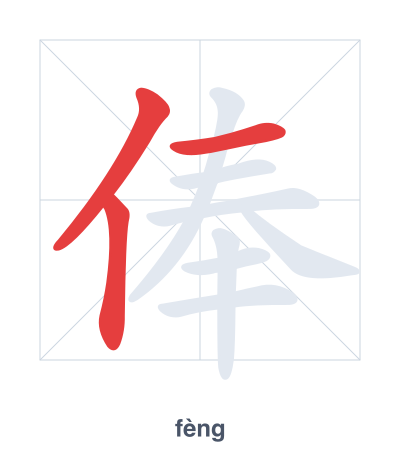
Open Hanzi Writer to see the animated stroke order and practice writing 俸 with real-time feedback.
The character 俸 (fèng) is written with 10 strokes. Follow the standard Chinese stroke order: top to bottom, left to right, outside before inside. The radical 亻 is one of its key components.
Practice the correct stroke order with the Hanzi Writer app to see animated stroke-by-stroke guidance with real-time feedback.
俸 means official's salary.
俸 is a compound character with the radical 亻 (person) on the left, and 奉 (fèng, meaning to offer or receive respectfully) on the right. Together, they depict a person receiving an officially offered payment, hence 'official's salary.' The right component 奉 itself combines a hand (below) presenting something valuable, reinforcing the idea of a formal stipend.
💡 Memory Tip: Picture a person (亻) bowing respectfully as they receive a heavy stack of cash (the 奉 part looks like two hands offering a pile of coins) as their official salary.
古代官员有俸禄。
gǔ dài guān yuán yǒu fèng lù
Ancient officials had salaries.
他的薪俸很高。
tā de xīn fèng hěn gāo
His salary is very high.
他因为犯错被减俸。
tā yīn wèi fàn cuò bèi jiǎn fèng
His salary was reduced because he made a mistake.
Open Hanzi Writer to see the animated stroke order and practice writing 俸 with real-time feedback.
✨ Animated stroke order · Handwriting recognition · HSK-graded practice · Free to use
俸 is composed of the radical 亻 (person) on the left, and 奉 (fèng, to offer) on the right. The person radical indicates a person's role, while 奉 suggests offering or receiving, together meaning a person's official salary, which is offered by the government.