俯 (fǔ) means "to bow, lean forward, or look down" in Chinese. It has 10 strokes with the radical 亻, and is HSK Level 7.
Rated 3.9/5 in difficulty (challenging).
Harder than 33% of HSK Level 7 characters.
Appears in 3+ common words including 俯视 (fǔ shì), 俯身 (fǔ shēn), 俯首 (fǔ shǒu).
Due to its 10 strokes, Hanzi Writer's error detection shows 俯 requires focused practice — most learners need 10+ attempts for consistent accuracy.
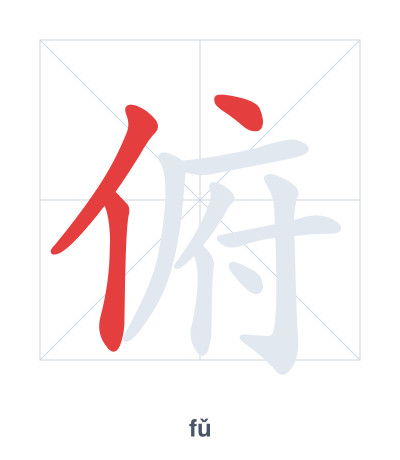
Open Hanzi Writer to see the animated stroke order and practice writing 俯 with real-time feedback.
The character 俯 (fǔ) is written with 10 strokes. Follow the standard Chinese stroke order: top to bottom, left to right, outside before inside. The radical 亻 is one of its key components.
Practice the correct stroke order with the Hanzi Writer app to see animated stroke-by-stroke guidance with real-time feedback.
俯 means to bow, lean forward, or look down.
As an HSK Level 7 character, 俯 is an intermediate-level character.
The character 俯 combines the person radical 亻 with 府 (a government office or mansion). A person (亻) in a formal setting like a mansion (府) would bow or lean forward as a sign of respect, creating the meaning 'to bow' or 'look down'.
💡 Memory Tip: Picture a person (亻) entering a mansion (府) with a low doorway, forcing them to bow and look down to get inside.
从山上俯视城市。
cóng shān shàng fǔ shì chéng shì
Looking down at the city from the mountain.
他俯身捡起地上的书。
tā fǔ shēn jiǎn qǐ dì shàng de shū
He leaned over to pick up the book on the ground.
他俯首认错。
tā fǔ shǒu rèn cuò
He bowed his head and admitted his mistake.
Open Hanzi Writer to see the animated stroke order and practice writing 俯 with real-time feedback.
✨ Animated stroke order · Handwriting recognition · HSK-graded practice · Free to use
俯 is made of two parts: the left radical 亻 (person) and the right part 府 (mansion). This suggests a person bending forward under a roof or in a low position. The combination visually represents someone leaning down or bowing.