闱 (wéi) means "examination hall / palace side gate" in Chinese. It has 7 strokes with the radical 门.
Rated 3.5/5 in difficulty (challenging).
Appears in 3+ common words including 春闱 (chūn wéi), 秋闱 (qiū wéi), 闱场 (wéi chǎng).
Due to its 7 strokes, Hanzi Writer's error detection shows 闱 requires focused practice — most learners need 10+ attempts for consistent accuracy.
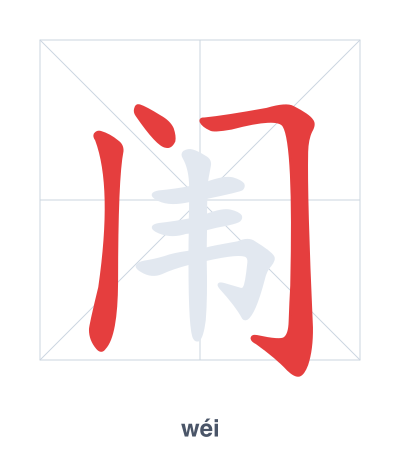
Open Hanzi Writer to see the animated stroke order and practice writing 闱 with real-time feedback.
The character 闱 (wéi) is written with 7 strokes. Follow the standard Chinese stroke order: top to bottom, left to right, outside before inside. The radical 门 is one of its key components.
Practice the correct stroke order with the Hanzi Writer app to see animated stroke-by-stroke guidance with real-time feedback.
闱 means examination hall / palace side gate.
This character combines the radical 门 (gate/door) with 韦 (wéi, originally meaning 'to surround' or 'leather'), where 韦 provides phonetic approximation. Historically, 闱 referred to the side gates of a palace or the gates of the imperial examination hall, emphasizing a restricted entry.
💡 Memory Tip: Picture a gate (门) wrapped in leather straps (韦), leading into a secret exam hall where scholars nervously await their fate.
他参加了春闱。
tā cān jiā le chūn wéi
He took part in the imperial spring examination.
秋闱在八月举行。
qiū wéi zài bā yuè jǔ xíng
The provincial civil service examination is held in August.
考生进入了闱场。
kǎo shēng jìn rù le wéi chǎng
The candidates entered the examination hall.
Open Hanzi Writer to see the animated stroke order and practice writing 闱 with real-time feedback.
✨ Animated stroke order · Handwriting recognition · HSK-graded practice · Free to use
The character 闱 is formed by the radical 门 (gate/door) on the outside and the phonetic component 韦 (wéi) on the inside. The radical 门 suggests that the character is related to gates or entrances, specifically a side gate of a palace. The component 韦 provides the pronunciation wéi and does not directly contribute to the meaning.