闯 (chuǎng) means "to rush / to dash / to charge" in Chinese. It has 6 strokes with the radical 门, and is HSK Level 5.
Rated 3.2/5 in difficulty (challenging).
Harder than 17% of HSK Level 5 characters.
Appears in 3+ common words including 闯红灯 (chuǎng hóng dēng), 闯祸 (chuǎng huò), 闯进 (chuǎng jìn).
Due to its 6 strokes, Hanzi Writer's error detection shows 闯 requires focused practice — most learners need 10+ attempts for consistent accuracy.
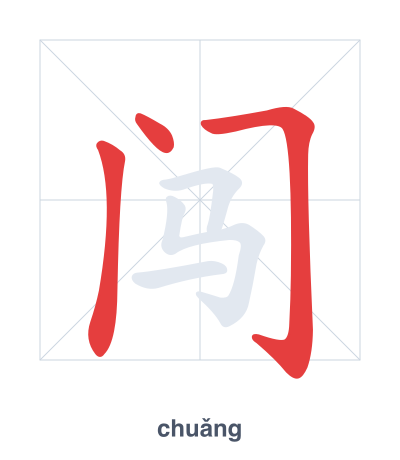
Open Hanzi Writer to see the animated stroke order and practice writing 闯 with real-time feedback.
The character 闯 (chuǎng) is written with 6 strokes. Follow the standard Chinese stroke order: top to bottom, left to right, outside before inside. The radical 门 is one of its key components.
Practice the correct stroke order with the Hanzi Writer app to see animated stroke-by-stroke guidance with real-time feedback.
闯 means to rush / to dash / to charge.
As an HSK Level 5 character, 闯 is an intermediate-level character.
闯 is a compound character combining 门 (door/gate) and 马 (horse). The image of a horse bursting through a gate vividly represents the meaning of rushing or charging forward forcefully.
💡 Memory Tip: Picture a horse (马) smashing through a closed door (门) in a wild, headlong dash.
不要闯红灯。
bú yào chuǎng hóng dēng
Don't run a red light.
他又闯祸了。
tā yòu chuǎng huò le
He got into trouble again.
小猫闯进了家。
xiǎo māo chuǎng jìn le jiā
The kitten burst into the house.
Open Hanzi Writer to see the animated stroke order and practice writing 闯 with real-time feedback.
✨ Animated stroke order · Handwriting recognition · HSK-graded practice · Free to use
闯 combines the radical 门 (door/gate) on the outside with the horse radical 马 inside. The image is of a horse charging through a gate, which matches the meaning of rushing or dashing. The door shows the passage, and the horse shows forceful movement.