闸 (zhá) means "Sluice; gate; brake" in Chinese. It has 8 strokes with the radical 门, and is HSK Level 7.
Rated 3.7/5 in difficulty (challenging).
Harder than 32% of HSK Level 7 characters.
Appears in 3+ common words including 水闸 (shuǐ zhá), 电闸 (diàn zhá), 闸门 (zhá mén).
Due to its 8 strokes, Hanzi Writer's error detection shows 闸 requires focused practice — most learners need 10+ attempts for consistent accuracy.
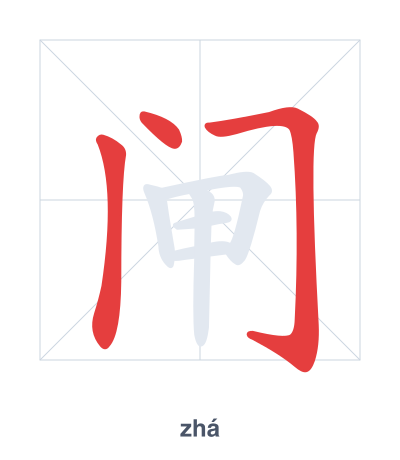
Open Hanzi Writer to see the animated stroke order and practice writing 闸 with real-time feedback.
The character 闸 (zhá) is written with 8 strokes. Follow the standard Chinese stroke order: top to bottom, left to right, outside before inside. The radical 门 is one of its key components.
Practice the correct stroke order with the Hanzi Writer app to see animated stroke-by-stroke guidance with real-time feedback.
闸 means Sluice; gate; brake.
As an HSK Level 7 character, 闸 is an intermediate-level character.
闸 combines the radical 门 (door/gate) with 甲 (armor/plate), suggesting a gate fitted with a movable plate that can block water flow, like a sluice gate. This mechanism also extends to the meaning of brake, as it stops motion.
💡 Memory Tip: Imagine a gate (门) with a heavy armored plate (甲) that slams down to block a rushing river or stop a speeding train.
水闸关上了。
shuǐ zhá guān shàng le
The sluice gate is closed.
请拉下电闸。
qǐng lā xià diàn zhá
Please pull down the circuit breaker.
闸门打开了。
zhá mén dǎ kāi le
The sluice gate is open.
Open Hanzi Writer to see the animated stroke order and practice writing 闸 with real-time feedback.
✨ Animated stroke order · Handwriting recognition · HSK-graded practice · Free to use
闸 combines the radical 门 (door/gate) on the outside, with 甲 (first/armor) inside. The 门 radical hints that the character relates to a gate or barrier, while 甲 (first) can suggest the idea of controlling the primary flow, like a sluice gate regulating water.