查 (chá/zhā) means "to check or investigate" in Chinese. It has 9 strokes with the radical 木, and is HSK Level 2.
Rated 3.5/5 in difficulty (challenging).
Harder than 64% of HSK Level 2 characters.
Appears in 4+ common words including 检查 (jiǎn chá), 查词典 (chá cí diǎn), 调查 (diào chá).
Due to its 9 strokes, Hanzi Writer's error detection shows 查 requires focused practice — most learners need 10+ attempts for consistent accuracy.
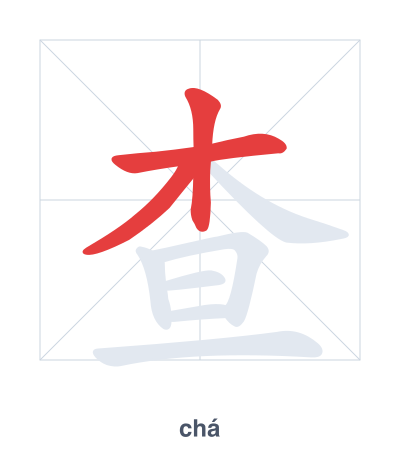
Open Hanzi Writer to see the animated stroke order and practice writing 查 with real-time feedback.
The character 查 (chá/zhā) is written with 9 strokes. Follow the standard Chinese stroke order: top to bottom, left to right, outside before inside. The radical 木 is one of its key components.
Practice the correct stroke order with the Hanzi Writer app to see animated stroke-by-stroke guidance with real-time feedback.
查 means to check or investigate.
This is a polyphonic character with readings: chá, zhā.
As an HSK Level 2 character, 查 is among the first characters beginners learn.
The character 查 combines the radical 木 (tree) with 旦 (dawn). Originally, it evoked the image of inspecting or investigating something like trees or wooden objects at sunrise, when light reveals details. The bottom part 旦, meaning dawn, suggests the start of a careful examination.
💡 Memory Tip: Picture yourself checking a tree (木) at dawn (旦) for any hidden marks or damage.
老师在检查作业。
lǎo shī zài jiǎn chá zuò yè
The teacher is checking homework.
如果你不认识这个生字,请翻开词典查词典。
rú guǒ nǐ bù rèn shí zhè ge shēng zì , qǐng fān kāi cí diǎn chá cí diǎn 。
If you don't know this new character, please open the dictionary and look it up.
公司在做市场调查。
gōng sī zài zuò shì chǎng diào chá
The company is conducting market research.
这个人姓查。
zhè gè rén xìng zhā.
This person's surname is Zha.
Open Hanzi Writer to see the animated stroke order and practice writing 查 with real-time feedback.
✨ Animated stroke order · Handwriting recognition · HSK-graded practice · Free to use
查 is made of two parts: the top is 木 (wood/tree), which is the radical, and the bottom is 旦 (dawning sun). The wood radical hints at the original practice of examining wooden objects, while 旦 gives a clue to the pronunciation (chá). Together they form the idea of checking or inspecting something carefully.