读 (dú) means "To read; to study" in Chinese. It has 10 strokes with the radical 讠, and is HSK Level 1.
Rated 3.4/5 in difficulty (challenging).
Harder than 75% of HSK Level 1 characters.
Appears in 3+ common words including 读书 (dú shū), 阅读 (yuè dú), 读音 (dú yīn).
Due to its 10 strokes, Hanzi Writer's error detection shows 读 requires focused practice — most learners need 10+ attempts for consistent accuracy.
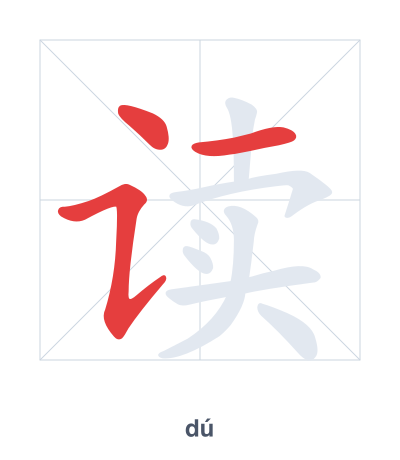
Open Hanzi Writer to see the animated stroke order and practice writing 读 with real-time feedback.
The character 读 (dú) is written with 10 strokes. Follow the standard Chinese stroke order: top to bottom, left to right, outside before inside. The radical 讠 is one of its key components.
Practice the correct stroke order with the Hanzi Writer app to see animated stroke-by-stroke guidance with real-time feedback.
读 means To read; to study.
As an HSK Level 1 character, 读 is among the first characters beginners learn.
读 combines the radical 讠 (speech/words) with 卖 (to sell). Originally written as 讀, it depicts the act of reading aloud as if 'selling' words with your voice. Thus the character connects speaking to the process of reading and studying.
💡 Memory Tip: Picture a seller (卖) shouting words (讠) from a book to sell it—that's reading aloud to study.
我喜欢在图书馆读书。
wǒ xǐ huān zài tú shū guǎn dú shū
I like studying in the library.
每天阅读很有好处。
měi tiān yuè dú hěn yǒu hǎo chù
Reading every day is very beneficial.
这个字的读音是什么?
zhè ge zì de dú yīn shì shén me
What is the pronunciation of this character?
Open Hanzi Writer to see the animated stroke order and practice writing 读 with real-time feedback.
✨ Animated stroke order · Handwriting recognition · HSK-graded practice · Free to use
读 is composed of the radical 讠 (speech) on the left and the component 卖 (to sell) on the right. The speech radical indicates that the character relates to language or communication, while 卖 originally provided a phonetic clue, together forming the meaning 'to read' or 'to study'.