闺 (guī) means "Boudoir; small door" in Chinese. It has 9 strokes with the radical 门, and is HSK Level 7.
Rated 4/5 in difficulty (challenging).
Harder than 47% of HSK Level 7 characters.
Appears in 3+ common words including 闺蜜 (guī mì), 闺女 (guī nǚ), 闺房 (guī fáng).
Due to its 9 strokes, Hanzi Writer's error detection shows 闺 requires focused practice — most learners need 10+ attempts for consistent accuracy.
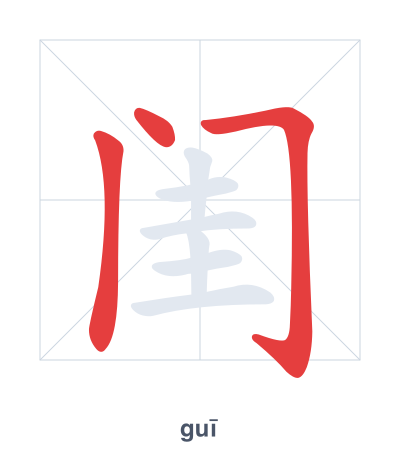
Open Hanzi Writer to see the animated stroke order and practice writing 闺 with real-time feedback.
The character 闺 (guī) is written with 9 strokes. Follow the standard Chinese stroke order: top to bottom, left to right, outside before inside. The radical 门 is one of its key components.
Practice the correct stroke order with the Hanzi Writer app to see animated stroke-by-stroke guidance with real-time feedback.
闺 means Boudoir; small door.
As an HSK Level 7 character, 闺 is an intermediate-level character.
闺 combines the radical 门 (door) with 圭, a jade tablet that also provides pronunciation. Originally, it referred to a small door or gate, and later came to denote a woman's private chamber or boudoir, emphasizing seclusion and intimacy.
💡 Memory Tip: Picture a jade tablet (圭) hanging on a small door (门), marking the entrance to a lady's private boudoir.
她是我的闺蜜。
tā shì wǒ de guī mì
She is my best friend.
他有个好闺女。
tā yǒu gè hǎo guī nǚ
He has a good daughter.
这是她的闺房。
zhè shì tā de guī fáng
This is her private chamber.
Open Hanzi Writer to see the animated stroke order and practice writing 闺 with real-time feedback.
✨ Animated stroke order · Handwriting recognition · HSK-graded practice · Free to use
闺 is made of the radical 门 (door) on the outside and 圭 (a jade tablet) on the inside. The door radical suggests an enclosed space, and 圭 gives the sound while also hinting at something precious or refined. Together they represent a private room for a lady, called a boudoir.