随 (suí) means "To follow / Along with" in Chinese. It has 11 strokes with the radical 阝, and is HSK Level 2.
Rated 3.4/5 in difficulty (challenging).
Harder than 59% of HSK Level 2 characters.
Appears in 3+ common words including 随便 (suí biàn), 随时 (suí shí), 随手 (suí shǒu).
Due to its 11 strokes, Hanzi Writer's error detection shows 随 requires focused practice — most learners need 10+ attempts for consistent accuracy.
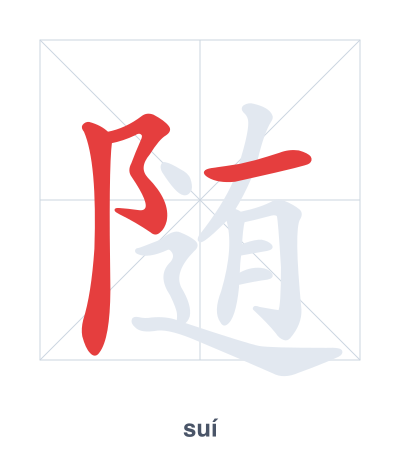
Open Hanzi Writer to see the animated stroke order and practice writing 随 with real-time feedback.
The character 随 (suí) is written with 11 strokes. Follow the standard Chinese stroke order: top to bottom, left to right, outside before inside. The radical 阝 is one of its key components.
Practice the correct stroke order with the Hanzi Writer app to see animated stroke-by-stroke guidance with real-time feedback.
随 means To follow / Along with.
As an HSK Level 2 character, 随 is among the first characters beginners learn.
The character 随 originally had the walking radical 辶 in its traditional form 隨, with 隋 as a phonetic component. In simplified Chinese, the radical changed to 阝 (hill/mound), still evoking movement along a path. Together, the elements suggest following a route or someone along a journey.
💡 Memory Tip: Follow the left ear (阝) to the left (左) under the moon (月) to remember 随 (follow).
请随便坐,别客气。
qǐng suí biàn zuò bié kè qì
Please have a seat, make yourself at home.
有事请随时给我打电话。
yǒu shì qǐng suí shí gěi wǒ dǎ diàn huà
Please call me anytime if you need anything.
离开时请随手关灯。
lí kāi shí qǐng suí shǒu guān dēng
Please turn off the lights when you leave.
Open Hanzi Writer to see the animated stroke order and practice writing 随 with real-time feedback.
✨ Animated stroke order · Handwriting recognition · HSK-graded practice · Free to use
The character 随 is made of three parts: the left radical 阝 (mound), 有 (have), and 辶 (walk). Together they suggest walking along a mound or path, which connects to the meaning 'to follow' or 'along with'.