望 (wàng) means "To look; to hope; full moon" in Chinese. It has 11 strokes with the radical 月, and is HSK Level 3.
Rated 4.2/5 in difficulty (advanced).
Harder than 80% of HSK Level 3 characters.
Appears in 3+ common words including 希望 (xī wàng), 望见 (wàng jiàn), 愿望 (yuàn wàng).
Due to its 11 strokes, Hanzi Writer's error detection shows 望 requires focused practice — most learners need 10+ attempts for consistent accuracy.
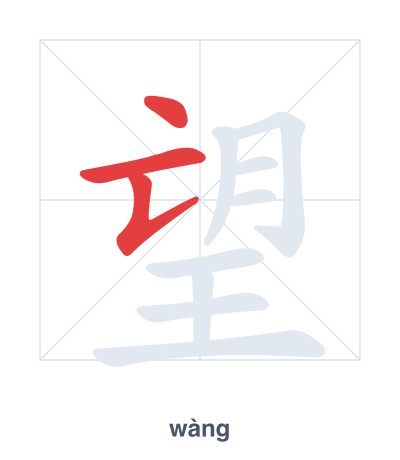
Open Hanzi Writer to see the animated stroke order and practice writing 望 with real-time feedback.
The character 望 (wàng) is written with 11 strokes. Follow the standard Chinese stroke order: top to bottom, left to right, outside before inside. The radical 月 is one of its key components.
Practice the correct stroke order with the Hanzi Writer app to see animated stroke-by-stroke guidance with real-time feedback.
望 means To look; to hope; full moon.
As an HSK Level 3 character, 望 is an intermediate-level character.
In ancient script, 望 showed a person (臣, an eye) standing on a mound gazing at the moon (月), meaning to look into the distance. Over time, the person component simplified to 亡, and the mound was lost, leaving the eye-moon combination to convey looking, hoping, and the full moon.
💡 Memory Tip: Picture a hunched figure (亡) staring up at the moon (月) with hope, waiting for it to become full.
我希望你能来。
wǒ xī wàng nǐ néng lái
I hope you can come.
我望见了大海。
wǒ wàng jiàn le dà hǎi
I saw the sea.
你的愿望是什么?
nǐ de yuàn wàng shì shén me
What is your wish?
Open Hanzi Writer to see the animated stroke order and practice writing 望 with real-time feedback.
✨ Animated stroke order · Handwriting recognition · HSK-graded practice · Free to use
望 combines 亡 (wáng, meaning 'to die' or 'disappear') on top of 月 (yuè, 'moon') with 王 (wáng, 'king') below. The original idea was looking at the moon from a high place, which evolved into meanings of 'to look' and 'to hope'. The moon component directly connects to the 'full moon' meaning.