咬 (yǎo) means "to bite" in Chinese. It has 9 strokes with the radical 口, and is HSK Level 5.
Rated 4/5 in difficulty (challenging).
Harder than 47% of HSK Level 5 characters.
Appears in 3+ common words including 咬一口 (yǎo yī kǒu), 咬牙 (yǎo yá), 叮咬 (dīng yǎo).
Due to its 9 strokes, Hanzi Writer's error detection shows 咬 requires focused practice — most learners need 10+ attempts for consistent accuracy.
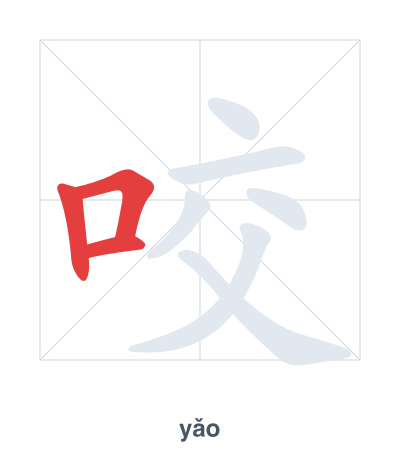
Open Hanzi Writer to see the animated stroke order and practice writing 咬 with real-time feedback.
The character 咬 (yǎo) is written with 9 strokes. Follow the standard Chinese stroke order: top to bottom, left to right, outside before inside. The radical 口 is one of its key components.
Practice the correct stroke order with the Hanzi Writer app to see animated stroke-by-stroke guidance with real-time feedback.
咬 means to bite.
As an HSK Level 5 character, 咬 is an intermediate-level character.
咬 combines the mouth radical (口) with 交, which originally depicted crossed legs and suggests intertwining or crossing. Together, the character visually represents teeth coming together in a biting action.
💡 Memory Tip: Picture a mouth (口) with crossed teeth (交) clenching down hard to bite.
咬一口苹果吧。
yǎo yī kǒu píng guǒ ba
Take a bite of the apple.
他咬牙坚持到底。
tā yǎo yá jiān chí dào dǐ
He gritted his teeth and persevered to the end.
别被蚊子叮咬了。
bié bèi wén zi dīng yǎo le
Don't get bitten by mosquitoes.
Open Hanzi Writer to see the animated stroke order and practice writing 咬 with real-time feedback.
✨ Animated stroke order · Handwriting recognition · HSK-graded practice · Free to use
咬 is made of the radical 口 (mouth) on the left, which directly shows the action involves the mouth. The right part is 交 (to cross), which visually suggests the upper and lower teeth crossing together when you bite.