叮 (dīng) means "to sting; to bite; to remind repeatedly" in Chinese. It has 5 strokes with the radical 口, and is HSK Level 7.
Rated 2.9/5 in difficulty (moderate).
Harder than 6% of HSK Level 7 characters.
Appears in 3+ common words including 叮嘱 (dīng zhǔ), 叮咬 (dīng yǎo), 叮当 (dīng dāng).
Hanzi Writer's stroke validation shows learners typically need 5-8 attempts to write 叮 with correct proportion and order.
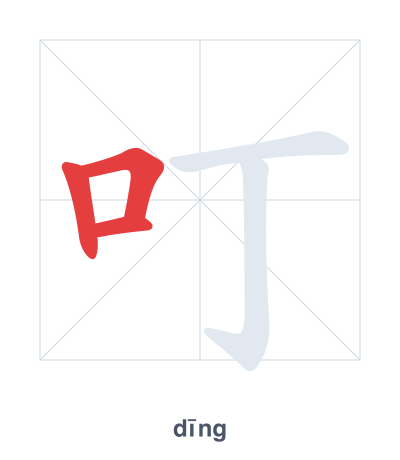
Open Hanzi Writer to see the animated stroke order and practice writing 叮 with real-time feedback.
The character 叮 (dīng) is written with 5 strokes. Follow the standard Chinese stroke order: top to bottom, left to right, outside before inside. The radical 口 is one of its key components.
Practice the correct stroke order with the Hanzi Writer app to see animated stroke-by-stroke guidance with real-time feedback.
叮 means to sting; to bite; to remind repeatedly.
As an HSK Level 7 character, 叮 is an intermediate-level character.
叮 is a phono-semantic compound character. The left side is the radical 口 (mouth, suggesting sound or speech), and the right side is 丁 (dīng, meaning 'nail'), which gives the pronunciation. Together, the mouth emphasizes a sharp, repeated sound or action—like a mosquito's sting or persistent reminders.
💡 Memory Tip: Picture a mosquito's tiny mouth (口) like a sharp nail (丁) that stings you and then buzzes repeatedly to remind you it's still there.
妈妈叮嘱我早点回。
mā mā dīng zhǔ wǒ zǎo diǎn huí
Mom told me to come back early.
我被蚊子叮咬了。
wǒ bèi wén zi dīng yǎo le
I was bitten by a mosquito.
门铃叮当响。
mén líng dīng dāng xiǎng
The doorbell is ringing.
Open Hanzi Writer to see the animated stroke order and practice writing 叮 with real-time feedback.
✨ Animated stroke order · Handwriting recognition · HSK-graded practice · Free to use
叮 combines the radical 口 (mouth) on the left and 丁 (dīng, nail) on the right. The mouth radical suggests speaking or sound, while 丁 gives the sound clue, together indicating actions like stinging (bee's mouth) or repeatedly reminding (speaking like a nail).