谦 (qiān) means "humble; modest" in Chinese. It has 12 strokes with the radical 讠, and is HSK Level 6.
Rated 3.9/5 in difficulty (challenging).
Harder than 43% of HSK Level 6 characters.
Appears in 3+ common words including 谦虚 (qiān xū), 谦让 (qiān ràng), 谦辞 (qiān cí).
Due to its 12 strokes, Hanzi Writer's error detection shows 谦 requires focused practice — most learners need 10+ attempts for consistent accuracy.
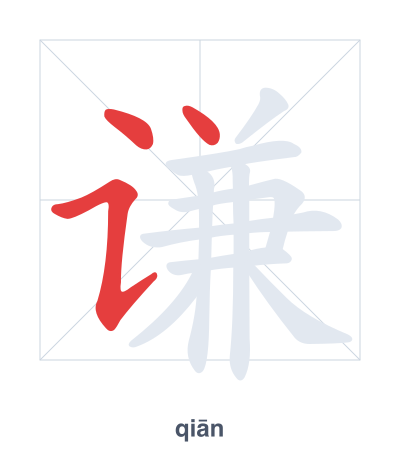
Open Hanzi Writer to see the animated stroke order and practice writing 谦 with real-time feedback.
The character 谦 (qiān) is written with 12 strokes. Follow the standard Chinese stroke order: top to bottom, left to right, outside before inside. The radical 讠 is one of its key components.
Practice the correct stroke order with the Hanzi Writer app to see animated stroke-by-stroke guidance with real-time feedback.
谦 means humble; modest.
As an HSK Level 6 character, 谦 is an intermediate-level character.
谦 combines the speech radical 讠 with 兼, which originally depicted a hand holding two rice stalks — symbolizing balance and evenness. This suggests speaking with measured, self-effacing words, reflecting a humble and modest attitude.
💡 Memory Tip: Imagine a humble speaker (讠) holding two perfectly balanced grains (兼) to remind themselves to keep their words modest and even.
他为人很谦虚。
tā wéi rén hěn qiān xū
He is very humble.
我们要互相谦让。
wǒ men yào hù xiāng qiān ràng
We should be modest and yield to each other.
这是一个谦辞。
zhè shì yí gè qiān cí
This is a humble expression.
Open Hanzi Writer to see the animated stroke order and practice writing 谦 with real-time feedback.
✨ Animated stroke order · Handwriting recognition · HSK-graded practice · Free to use
谦 combines the radical 讠 (speech) on the left and 兼 (jiān, 'to combine') on the right. The speech radical suggests that humility is expressed through words, while 兼 implies holding multiple qualities together without arrogance.