辞 (cí) means "to resign; to bid farewell; word; diction." in Chinese. It has 13 strokes with the radical 舌, and is HSK Level 5.
Rated 4.2/5 in difficulty (advanced).
Harder than 95% of HSK Level 5 characters.
Appears in 3+ common words including 辞职 (cí zhí), 辞典 (cí diǎn), 告辞 (gào cí).
Due to its 13 strokes, Hanzi Writer's error detection shows 辞 requires focused practice — most learners need 10+ attempts for consistent accuracy.
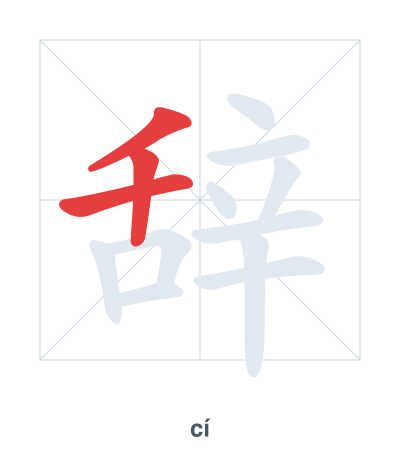
Open Hanzi Writer to see the animated stroke order and practice writing 辞 with real-time feedback.
The character 辞 (cí) is written with 13 strokes. Follow the standard Chinese stroke order: top to bottom, left to right, outside before inside. The radical 舌 is one of its key components.
Practice the correct stroke order with the Hanzi Writer app to see animated stroke-by-stroke guidance with real-time feedback.
辞 means to resign; to bid farewell; word; diction..
As an HSK Level 5 character, 辞 is an intermediate-level character.
辞 combines the radical 舌 (tongue/speech) with the element 辛 (bitter/punishment), originally depicting spoken words in a legal or formal context — such as pleading in court — which later evolved to mean 'to resign' (as in formally stating one's departure) and 'diction' (the choice of words).
💡 Memory Tip: Imagine sticking out your tongue (舌) at a bitter boss (辛) while handing in your resignation letter.
他辞职了。
tā cí zhí le
He resigned.
我买了一本辞典。
wǒ mǎi le yī běn cí diǎn
I bought a dictionary.
我先告辞了。
wǒ xiān gào cí le
I'll take my leave now.
Open Hanzi Writer to see the animated stroke order and practice writing 辞 with real-time feedback.
✨ Animated stroke order · Handwriting recognition · HSK-graded practice · Free to use
辞 is composed of the radical 舌 (tongue) on the left and the component 辛 (bitter or spicy) on the right. The tongue relates to speaking and words, while 辛 can suggest difficulty or emotion, together forming ideas like saying bitter farewells or using careful words when resigning.