诹 (zōu) means "To consult; to choose" in Chinese. It has 10 strokes with the radical 讠.
Rated 3.9/5 in difficulty (challenging).
Appears in 3+ common words including 诹吉 (zōu jí), 诹议 (zōu yì), 诹访 (zōu fǎng).
Due to its 10 strokes, Hanzi Writer's error detection shows 诹 requires focused practice — most learners need 10+ attempts for consistent accuracy.
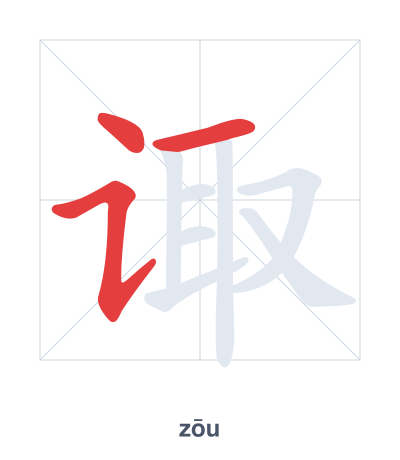
Open Hanzi Writer to see the animated stroke order and practice writing 诹 with real-time feedback.
The character 诹 (zōu) is written with 10 strokes. Follow the standard Chinese stroke order: top to bottom, left to right, outside before inside. The radical 讠 is one of its key components.
Practice the correct stroke order with the Hanzi Writer app to see animated stroke-by-stroke guidance with real-time feedback.
诹 means To consult; to choose.
诹 is a compound character formed from the radical 讠 (speech, depicting words) and the phonetic component 取 (qǔ, meaning 'to take' or 'choose'). The combination suggests 'taking speech' or gathering opinions, hence the meanings 'to consult' and 'to choose'.
💡 Memory Tip: Imagine a person using words (讠) to take (取) advice from a wise council before making a decision.
我们要诹吉开业。
wǒ men yào zōu jí kāi yè
We need to choose an auspicious day to open the business.
专家们正在诹议此事。
zhuān jiā men zhèng zài zōu yì cǐ shì
Experts are consulting and discussing this matter.
他去外地诹访民情。
tā qù wài dì zōu fǎng mín qíng
He went elsewhere to inquire about the people's conditions.
Open Hanzi Writer to see the animated stroke order and practice writing 诹 with real-time feedback.
✨ Animated stroke order · Handwriting recognition · HSK-graded practice · Free to use
The character 诹 is made of two parts: the radical 讠 on the left, which means speech or words, and the component 取 on the right, which means to take. Together, they suggest "taking speech" from someone, which leads to the meanings of consulting or choosing.