虚 (xū) means "Empty; false; weak." in Chinese. It has 11 strokes with the radical 虍, and is HSK Level 5.
Rated 4.2/5 in difficulty (advanced).
Harder than 91% of HSK Level 5 characters.
Appears in 3+ common words including 谦虚 (qiān xū), 虚心 (xū xīn), 虚弱 (xū ruò).
Due to its 11 strokes, Hanzi Writer's error detection shows 虚 requires focused practice — most learners need 10+ attempts for consistent accuracy.
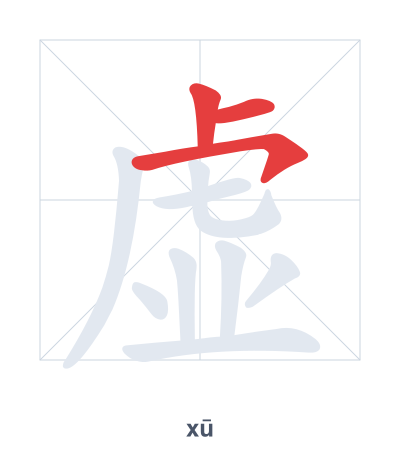
Open Hanzi Writer to see the animated stroke order and practice writing 虚 with real-time feedback.
The character 虚 (xū) is written with 11 strokes. Follow the standard Chinese stroke order: top to bottom, left to right, outside before inside. The radical 虍 is one of its key components.
Practice the correct stroke order with the Hanzi Writer app to see animated stroke-by-stroke guidance with real-time feedback.
虚 means Empty; false; weak..
As an HSK Level 5 character, 虚 is an intermediate-level character.
虚 originally depicted a tiger (虍) on a hill (丘), symbolizing a large, empty hill where tigers once roamed. Over time, it came to mean 'empty' or 'false,' as in something lacking substance.
💡 Memory Tip: Imagine a tiger (虍) standing on a hill (丘) and roaring, but the hill is completely empty—nothing there but echo.
他是一个谦虚的学生。
tā shì yí gè qiān xū de xué shēng
He is a humble student.
我们要虚心听取意见。
wǒ men yào xū xīn tīng qǔ yì jiàn
We should listen to opinions with an open mind.
生病让他变得虚弱。
shēng bìng ràng tā biàn dé xū ruò
Illness made him weak.
Open Hanzi Writer to see the animated stroke order and practice writing 虚 with real-time feedback.
✨ Animated stroke order · Handwriting recognition · HSK-graded practice · Free to use
The character 虚 combines the radical 虍 (tiger) on top and 丘 (hill) below. Together, they suggest a tiger’s empty den on a hill, which connects to the core meanings of "empty" and "false." This visual of an abandoned lair reinforces the idea of something hollow or insubstantial.