请 (qǐng) means "please / to invite" in Chinese. It has 10 strokes with the radical 讠, and is HSK Level 1.
Rated 3.4/5 in difficulty (challenging).
Harder than 74% of HSK Level 1 characters.
Appears in 3+ common words including 请客 (qǐng kè), 请假 (qǐng jià), 请问 (qǐng wèn).
Due to its 10 strokes, Hanzi Writer's error detection shows 请 requires focused practice — most learners need 10+ attempts for consistent accuracy.
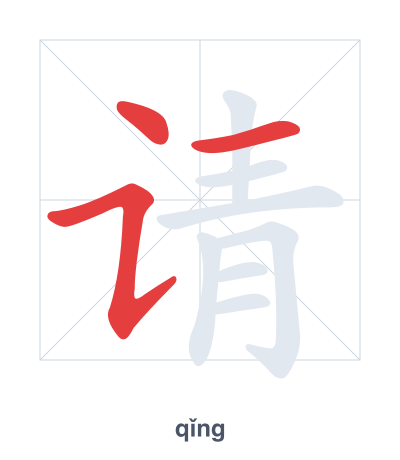
Open Hanzi Writer to see the animated stroke order and practice writing 请 with real-time feedback.
The character 请 (qǐng) is written with 10 strokes. Follow the standard Chinese stroke order: top to bottom, left to right, outside before inside. The radical 讠 is one of its key components.
Practice the correct stroke order with the Hanzi Writer app to see animated stroke-by-stroke guidance with real-time feedback.
请 means please / to invite.
As an HSK Level 1 character, 请 is among the first characters beginners learn.
请 is a compound character with the radical 讠 (speech) on the left and 青 (qīng, meaning 'blue/green' or 'clear') on the right. The speech radical indicates that the meaning involves words or requests, while 青 provides the pronunciation and hints at a 'clear' or polite tone. Originally, 请 meant 'to request' or 'to invite' someone formally through speech.
💡 Memory Tip: Picture yourself politely saying 'Please' (讠) while pointing at a clear, blue sky (青) to invite someone outside.
今天我请客。
jīn tiān wǒ qǐng kè
It's my treat today.
由于家里有些突发状况,他不得不向公司请假。
yóu yú jiā lǐ yǒu xiē tū fā zhuàng kuàng , tā bù dé bù xiàng gōng sī qǐng jià 。
Due to some emergencies at home, he had to ask the company for leave.
请问洗手间在哪儿?
qǐng wèn xǐ shǒu jiān zài nǎ ér
Excuse me, where is the restroom?
Open Hanzi Writer to see the animated stroke order and practice writing 请 with real-time feedback.
✨ Animated stroke order · Handwriting recognition · HSK-graded practice · Free to use
请 is made of the radical 讠 (speech) on the left and the phonetic component 青 (qīng, green/blue) on the right. The radical hints that the meaning involves spoken language, while the sound comes from 青. This fits its core meanings of politely requesting or inviting through words.