Hanzi Writer

How to Write 骗 (piàn) — Meaning “To cheat or deceive”

piàn HSK Level 5 12 strokes Radical: 马

骗 (piàn) means "To cheat or deceive" in Chinese. It has 12 strokes with the radical 马, and is HSK Level 5.

Rated 4.2/5 in difficulty (advanced).

Harder than 99% of HSK Level 5 characters.

Appears in 3+ common words including 骗子 (piàn zi), 骗人 (piàn rén), 欺骗 (qī piàn).

Due to its 12 strokes, Hanzi Writer's error detection shows 骗 requires focused practice — most learners need 10+ attempts for consistent accuracy.
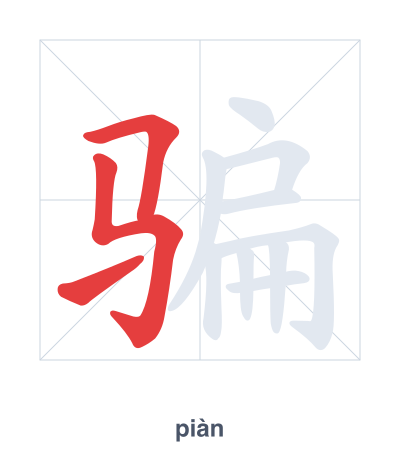
Stroke order practice for 骗 - piàn

Practice Writing 骗 (piàn)

Open Hanzi Writer to see the animated stroke order and practice writing 骗 with real-time feedback.

The character (piàn) is written with 12 strokes. Follow the standard Chinese stroke order: top to bottom, left to right, outside before inside. The radical is one of its key components.

Practice the correct stroke order with the Hanzi Writer app to see animated stroke-by-stroke guidance with real-time feedback.

means To cheat or deceive.

As an HSK Level 5 character, is an intermediate-level character.

Character
Pinyinpiàn (pian)
MeaningTo cheat or deceive
Strokes12
Radical
HSK Level5
Difficulty4.2/5

It combines 'horse' (马) with 'flat' (扁) for sound. Originally meaning 'to vault onto a horse,' it later extended to 'cheat'—perhaps because mounting swiftly involved a deceptive trick. The horse radical hints at the quick, cunning nature of deception.

💡 Memory Tip: Picture a horse (马) that is so flat (扁) it's just a painted cardboard cutout—used to cheat people into thinking it's real.

piàn zi
Swindler or cheater
piàn rén
To deceive people
qī piàn
to deceive; to cheat

别相信那个骗子。

bié xiāng xìn nà ge piàn zi

Don't believe that liar.

他从来不骗人。

tā cóng lái bù piàn rén

He never deceives anyone.

欺骗是不对的行为。

qī piàn shì bú duì de xíng wéi

Deception is wrong behavior.

Character Pinyin Strokes Radical
(current) piàn 12
10
chěng 10
yàn 10
Stroke order practice for 骗 - piàn

Practice Writing 骗 (piàn)

Open Hanzi Writer to see the animated stroke order and practice writing 骗 with real-time feedback.

✨ Animated stroke order · Handwriting recognition · HSK-graded practice · Free to use

Frequently Asked Questions about 骗

The left side is the radical 马 (horse), and the right side is 扁 (biǎn), which provides the pronunciation. While the exact origin is unclear, the horse radical may suggest an action, and the combination evolved to mean 'to cheat' or 'to deceive.'

More HSK Level 5 Characters

Characters with Radical 马

Other 12-Stroke Characters