驴 (lǘ) means "Donkey" in Chinese. It has 7 strokes with the radical 马.
Rated 3.5/5 in difficulty (challenging).
Appears in 3+ common words including 小驴 (xiǎo lǘ), 驴肉 (lǘ ròu), 驴友 (lǘ yǒu).
Due to its 7 strokes, Hanzi Writer's error detection shows 驴 requires focused practice — most learners need 10+ attempts for consistent accuracy.
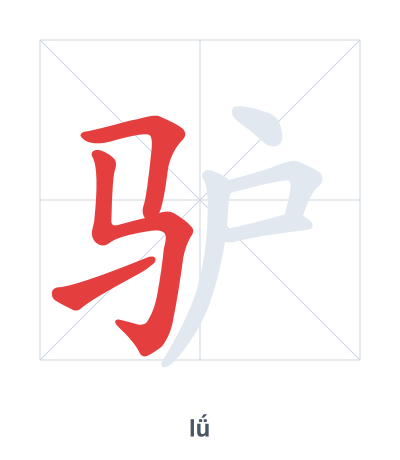
Open Hanzi Writer to see the animated stroke order and practice writing 驴 with real-time feedback.
The character 驴 (lǘ) is written with 7 strokes. Follow the standard Chinese stroke order: top to bottom, left to right, outside before inside. The radical 马 is one of its key components.
Practice the correct stroke order with the Hanzi Writer app to see animated stroke-by-stroke guidance with real-time feedback.
驴 means Donkey.
驴 (lǘ) is a semantic-phonetic compound: the radical 马 (horse) indicates it is a horse-like animal, while 户 (household) gives a clue to its pronunciation. The donkey was a common domestic animal, often kept near the household for transport and labor.
💡 Memory Tip: Picture a horse (马) with a door (户) strapped to its back, stubbornly refusing to move—that's a donkey.
草地上有一头小驴。
cǎo dì shàng yǒu yī tóu xiǎo lǘ
There is a little donkey on the grass.
驴肉火烧很好吃。
lǘ ròu huǒ shāo hěn hǎo chī
Donkey meat burgers are delicious.
他是一个资深驴友。
tā shì yí gè zī shēn lǘ yǒu
He is an experienced backpacker.
Open Hanzi Writer to see the animated stroke order and practice writing 驴 with real-time feedback.
✨ Animated stroke order · Handwriting recognition · HSK-graded practice · Free to use
驴 is composed of the radical 马 (horse) on the left and the component 户 (door/household) on the right. The 马 radical indicates that 驴 is a type of animal related to horses, while 户 suggests it is a domestic animal kept near the house. Together they form the meaning "donkey."