驯 (xùn) means "To tame; to train" in Chinese. It has 6 strokes with the radical 马, and is HSK Level 7.
Rated 3.2/5 in difficulty (challenging).
Harder than 12% of HSK Level 7 characters.
Appears in 3+ common words including 驯服 (xùn fú), 驯养 (xùn yǎng), 驯良 (xùn liáng).
Due to its 6 strokes, Hanzi Writer's error detection shows 驯 requires focused practice — most learners need 10+ attempts for consistent accuracy.
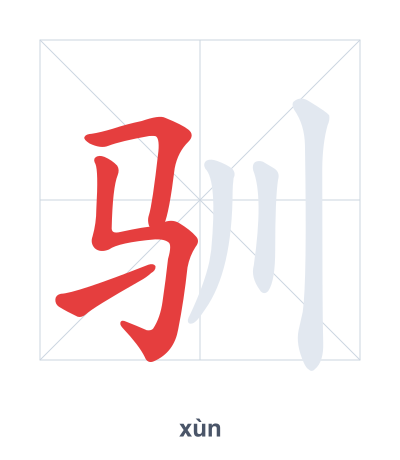
Open Hanzi Writer to see the animated stroke order and practice writing 驯 with real-time feedback.
The character 驯 (xùn) is written with 6 strokes. Follow the standard Chinese stroke order: top to bottom, left to right, outside before inside. The radical 马 is one of its key components.
Practice the correct stroke order with the Hanzi Writer app to see animated stroke-by-stroke guidance with real-time feedback.
驯 means To tame; to train.
As an HSK Level 7 character, 驯 is an intermediate-level character.
驯 combines the radical 马 (horse) with 川 (river, stream). The character suggests guiding a horse to move smoothly like flowing water, reflecting the idea of taming or training an animal to be docile and obedient.
💡 Memory Tip: Picture a horse (马) gracefully flowing like a river (川) after being trained to move calmly and smoothly.
这只野马被驯服了。
zhè zhǐ yě mǎ bèi xùn fú le
This wild horse has been tamed.
他在家里驯养小猫。
tā zài jiā lǐ xùn yǎng xiǎo māo
He is domesticating a kitten at home.
这只小羊非常驯良。
zhè zhǐ xiǎo yáng fēi cháng xùn liáng
This little lamb is very docile.
Open Hanzi Writer to see the animated stroke order and practice writing 驯 with real-time feedback.
✨ Animated stroke order · Handwriting recognition · HSK-graded practice · Free to use
驯 is composed of the radical 马 (horse) on the left and the phonetic component 川 (river) on the right. The horse radical connects to the idea of training or taming horses, while 川 provides a sound hint for the pronunciation xùn. Together, they form the meaning 'to tame' or 'to train'.