验 (yàn) means "To verify; to test" in Chinese. It has 10 strokes with the radical 马, and is HSK Level 3.
Rated 4.2/5 in difficulty (advanced).
Harder than 100% of HSK Level 3 characters.
Appears in 3+ common words including 实验 (shí yàn), 经验 (jīng yàn), 验证 (yàn zhèng).
Due to its 10 strokes, Hanzi Writer's error detection shows 验 requires focused practice — most learners need 10+ attempts for consistent accuracy.
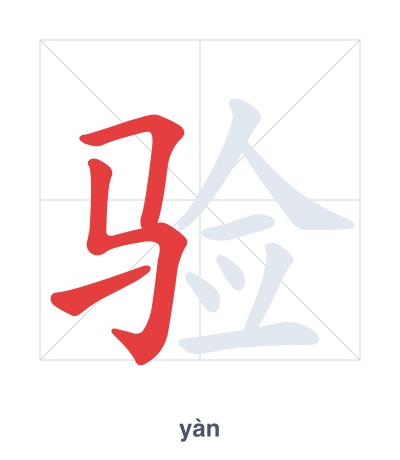
Open Hanzi Writer to see the animated stroke order and practice writing 验 with real-time feedback.
The character 验 (yàn) is written with 10 strokes. Follow the standard Chinese stroke order: top to bottom, left to right, outside before inside. The radical 马 is one of its key components.
Practice the correct stroke order with the Hanzi Writer app to see animated stroke-by-stroke guidance with real-time feedback.
验 means To verify; to test.
As an HSK Level 3 character, 验 is an intermediate-level character.
The character 验 combines the radical 马 (horse) with the phonetic component 佥 (qiān, meaning 'all' or 'together'), originally referring to the inspection or testing of horses, and later broadened to mean verifying or testing anything.
💡 Memory Tip: Imagine a horse (马) undergoing a rigorous test where a person (佥, resembling a figure with a checklist) checks 'all' its abilities.
我们在实验室做实验。
wǒ men zài shí yàn shì zuò shí yàn
We are doing experiments in the lab.
他有很多工作经验。
tā yǒu hěn duō gōng zuò jīng yàn
He has a lot of work experience.
请验证你的手机号码。
qǐng yàn zhèng nǐ de shǒu jī hào mǎ
Please verify your phone number.
Open Hanzi Writer to see the animated stroke order and practice writing 验 with real-time feedback.
✨ Animated stroke order · Handwriting recognition · HSK-graded practice · Free to use
验 is made of the radical 马 (horse) on the left and 佥 (qiān, meaning 'all' or 'to assemble') on the right. The horse radical hints that the original meaning was about inspecting horses, which later expanded to testing and verifying things in general. The right side gives a phonetic clue, though the tones differ (yàn vs. qiān).