驭 (yù) means "To drive; to control" in Chinese. It has 5 strokes with the radical 马, and is HSK Level 7.
Rated 2.9/5 in difficulty (moderate).
Harder than 8% of HSK Level 7 characters.
Appears in 3+ common words including 驾驭 (jià yù), 驭手 (yù shǒu), 驭使 (yù shǐ).
Hanzi Writer's stroke validation shows learners typically need 5-8 attempts to write 驭 with correct proportion and order.
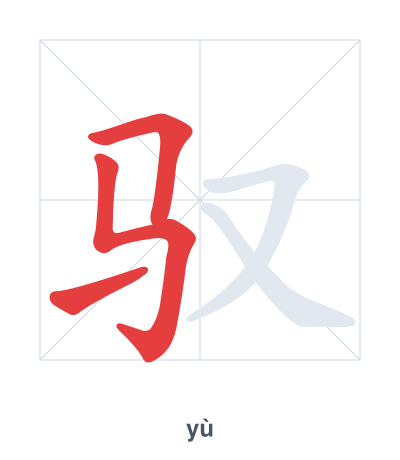
Open Hanzi Writer to see the animated stroke order and practice writing 驭 with real-time feedback.
The character 驭 (yù) is written with 5 strokes. Follow the standard Chinese stroke order: top to bottom, left to right, outside before inside. The radical 马 is one of its key components.
Practice the correct stroke order with the Hanzi Writer app to see animated stroke-by-stroke guidance with real-time feedback.
驭 means To drive; to control.
As an HSK Level 7 character, 驭 is an intermediate-level character.
驭 is a compound character with 马 (horse) on the left and 又 (right hand) on the right. The hand holding reins or a whip signifies controlling or driving a horse.
💡 Memory Tip: Picture a horse (马) being steered by a firm hand (又) on the reins to control its direction.
他能驾驭这辆新车。
tā néng jià yù zhè liàng xīn chē
He can handle this new car.
驭手在赶马车。
yù shǒu zài gǎn mǎ chē
The driver is driving the horse carriage.
他在驭使牛耕地。
tā zài yù shǐ niú gēng dì
He is driving an ox to plow the field.
Open Hanzi Writer to see the animated stroke order and practice writing 驭 with real-time feedback.
✨ Animated stroke order · Handwriting recognition · HSK-graded practice · Free to use
驭 is composed of the radical 马 (horse) on the left and 又 (right hand) on the right. The horse radical connects to driving a horse-drawn vehicle, while 又 represents the hand holding the reins to control the horse. Together they convey the idea of "driving" or "controlling" a horse.