马 (mǎ) means "Horse" in Chinese. It has 3 strokes with the radical 马, and is HSK Level 1.
Rated 1.7/5 in difficulty (beginner-friendly).
Harder than 11% of HSK Level 1 characters.
Appears in 3+ common words including 马上 (mǎ shàng), 骑马 (qí mǎ), 马路 (mǎ lù).
In the Hanzi Writer app, most learners master 马 within 3 practice attempts using stroke-by-stroke animation.
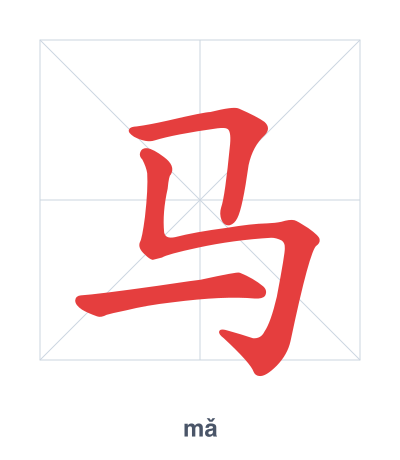
Open Hanzi Writer to see the animated stroke order and practice writing 马 with real-time feedback.
The character 马 (mǎ) is written with 3 strokes. Follow the standard Chinese stroke order: top to bottom, left to right, outside before inside. The radical 马 is one of its key components.
Practice the correct stroke order with the Hanzi Writer app to see animated stroke-by-stroke guidance with real-time feedback.
马 means Horse.
As an HSK Level 1 character, 马 is among the first characters beginners learn.
马 is a pictograph that originally depicted a horse in side view, showing its head, mane, legs, and tail. Over centuries, the shape was simplified to just three strokes, but the modern form still faintly suggests a horse's head with a flowing mane and a single back leg.
💡 Memory Tip: Imagine the top hook as the horse's head and neck, the middle line as its body, and the bottom swoop as its swishing tail galloping forward.
我马上就到学校。
wǒ mǎ shàng jiù dào xué xiào
I'll be at school very soon.
他喜欢在草原骑马。
tā xǐ huān zài cǎo yuán qí mǎ
He likes riding horses on the grasslands.
过马路要看红绿灯。
guò mǎ lù yào kàn hóng lǜ dēng
You must watch the traffic lights when crossing the road.
Open Hanzi Writer to see the animated stroke order and practice writing 马 with real-time feedback.
✨ Animated stroke order · Handwriting recognition · HSK-graded practice · Free to use
The character 马 is a pictograph that originally depicted a horse's head, mane, and legs. Its current simplified form uses three strokes to abstractly represent a horse's shape. The radical 马 is itself, so it often appears in words related to horses or riding.