啤 (pí) means "Beer (morpheme)" in Chinese. It has 11 strokes with the radical 口, and is HSK Level 3.
Rated 4.2/5 in difficulty (advanced).
Harder than 70% of HSK Level 3 characters.
Appears in 3+ common words including 啤酒 (pí jiǔ), 扎啤 (zhā pí), 啤酒杯 (pí jiǔ bēi).
Due to its 11 strokes, Hanzi Writer's error detection shows 啤 requires focused practice — most learners need 10+ attempts for consistent accuracy.
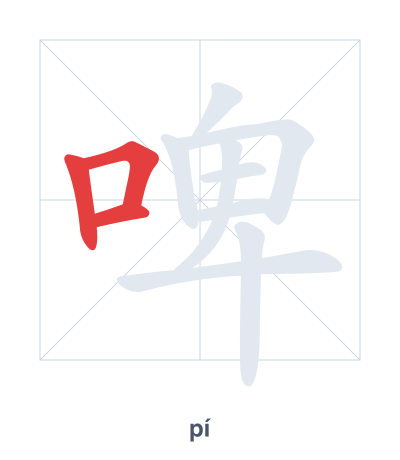
Open Hanzi Writer to see the animated stroke order and practice writing 啤 with real-time feedback.
The character 啤 (pí) is written with 11 strokes. Follow the standard Chinese stroke order: top to bottom, left to right, outside before inside. The radical 口 is one of its key components.
Practice the correct stroke order with the Hanzi Writer app to see animated stroke-by-stroke guidance with real-time feedback.
啤 means Beer (morpheme).
As an HSK Level 3 character, 啤 is an intermediate-level character.
啤 is a phono-semantic compound created for the loanword 'beer'. The radical 口 (mouth) indicates it's a beverage you drink, while 卑 (bēi) contributes the sound pí (though 卑 itself means 'low' or 'humble'). Together, they form a character that visually suggests 'putting your mouth to a low glass of beer'.
💡 Memory Tip: Imagine you put your mouth (口) down to the low (卑) glass to sip some beer.
我想喝冰啤酒。
wǒ xiǎng hē bīng pí jiǔ
I want to drink ice-cold beer.
我们要两杯扎啤。
wǒ men yào liǎng bēi zhā pí
We want two draft beers.
桌上有一个啤酒杯。
zhuō shàng yǒu yí gè pí jiǔ bēi
There is a beer mug on the table.
Open Hanzi Writer to see the animated stroke order and practice writing 啤 with real-time feedback.
✨ Animated stroke order · Handwriting recognition · HSK-graded practice · Free to use
啤 is a phono-semantic compound: the left radical 口 (mouth) suggests drinking or the mouth, and the right part 卑 gives the pronunciation pí. Although 卑 originally means humble, together they form a character used specifically for the sound in the word for beer from English.