呲 (cī/zī) means "to bare (one's teeth)" in Chinese. It has 9 strokes with the radical 口.
Rated 4/5 in difficulty (challenging).
Appears in 3+ common words including 呲牙 (zī yá), 挨呲 (āi cī), 呲 (cī).
Due to its 9 strokes, Hanzi Writer's error detection shows 呲 requires focused practice — most learners need 10+ attempts for consistent accuracy.
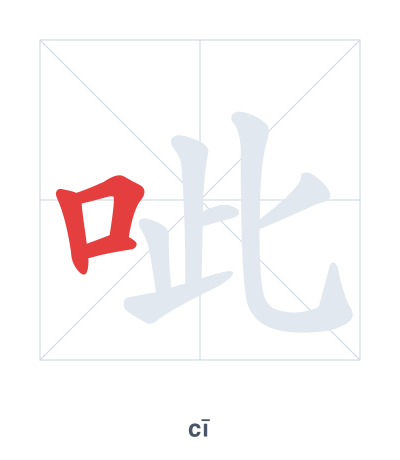
Open Hanzi Writer to see the animated stroke order and practice writing 呲 with real-time feedback.
The character 呲 (cī/zī) is written with 9 strokes. Follow the standard Chinese stroke order: top to bottom, left to right, outside before inside. The radical 口 is one of its key components.
Practice the correct stroke order with the Hanzi Writer app to see animated stroke-by-stroke guidance with real-time feedback.
呲 means to bare (one's teeth).
This is a polyphonic character with readings: cī, zī.
呲 is a phono-semantic compound. The radical 口 (mouth) indicates the action is performed with the mouth—baring teeth—while 此 (cǐ) provides the sound cue for cī.
💡 Memory Tip: Picture a mouth (口) that says 'cī' like a hiss, baring sharp teeth next to the character 此 (this).
他对着我呲牙笑。
tā duì zhe wǒ zī yá xiào
He grinned at me.
他今天挨呲了。
tā jīn tiān āi cī le
He got scolded today.
别呲着牙说话。
bié cī zhe yá shuō huà
Don't speak with your teeth bared.
Open Hanzi Writer to see the animated stroke order and practice writing 呲 with real-time feedback.
✨ Animated stroke order · Handwriting recognition · HSK-graded practice · Free to use
The character 呲 is formed by the radical 口 (mouth) on the left and the phonetic component 此 (cǐ) on the right. The 口 radical hints that the meaning involves an action of the mouth, and 此 gives the approximate pronunciation. Together, they create the idea of using the mouth to bare one's teeth.