咠 (qì) means "to whisper; to slander" in Chinese. It has 9 strokes with the radical 口.
Rated 4/5 in difficulty (challenging).
Appears in 3+ common words including 咠咠 (qì qì), 咠嗟 (qì jiē), 谗咠 (chán qì).
Due to its 9 strokes, Hanzi Writer's error detection shows 咠 requires focused practice — most learners need 10+ attempts for consistent accuracy.
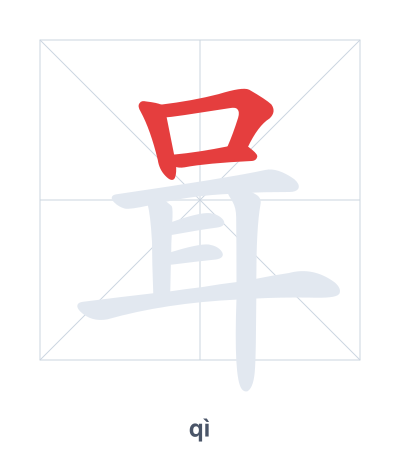
Open Hanzi Writer to see the animated stroke order and practice writing 咠 with real-time feedback.
The character 咠 (qì) is written with 9 strokes. Follow the standard Chinese stroke order: top to bottom, left to right, outside before inside. The radical 口 is one of its key components.
Practice the correct stroke order with the Hanzi Writer app to see animated stroke-by-stroke guidance with real-time feedback.
咠 means to whisper; to slander.
The character 咠 combines 口 (mouth) above 耳 (ear), depicting a mouth whispering directly into an ear. This visual of mouth-to-ear communication conveys the original meaning 'to whisper,' which later extended to 'to slander' as whispers often carry gossip.
💡 Memory Tip: Picture a mouth (口) leaning down to an ear (耳) to whisper a juicy secret—don't trust it, it might be slander!
两人咠咠私语。
liǎng rén qì qì sī yǔ
The two are whispering to each other.
他在咠嗟叹息。
tā zài qì jiē tàn xī
He is sighing and whispering.
莫听谗咠之言。
mò tīng chán qì zhī yán
Do not listen to slanderous words.
Open Hanzi Writer to see the animated stroke order and practice writing 咠 with real-time feedback.
✨ Animated stroke order · Handwriting recognition · HSK-graded practice · Free to use
咠 is made of two parts: the radical 口 (mouth) on top and 耳 (ear) below. The image of a mouth close to an ear represents whispering or slandering, which is the core meaning of this character.