咢 (è) means "to beat a drum; to startle" in Chinese. It has 9 strokes with the radical 口.
Rated 4/5 in difficulty (challenging).
Appears in 3+ common words including 咢咢 (è è), 咢然 (è rán), 蹇咢 (jiǎn è).
Due to its 9 strokes, Hanzi Writer's error detection shows 咢 requires focused practice — most learners need 10+ attempts for consistent accuracy.
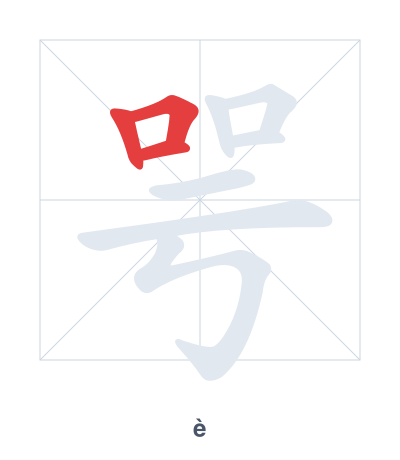
Open Hanzi Writer to see the animated stroke order and practice writing 咢 with real-time feedback.
The character 咢 (è) is written with 9 strokes. Follow the standard Chinese stroke order: top to bottom, left to right, outside before inside. The radical 口 is one of its key components.
Practice the correct stroke order with the Hanzi Writer app to see animated stroke-by-stroke guidance with real-time feedback.
咢 means to beat a drum; to startle.
咢 is a compound of 口 (mouth) and 屰 (opposite/contrary), where the mouth produces a startling sound—like a sudden drumbeat or shout—that goes against the usual calm.
💡 Memory Tip: Picture a wide-open mouth (口) screaming "EH!" as a drumstick (the 屰 shape) pounds a drum, startling everyone nearby.
他为人咢咢直言。
tā wéi rén è è zhí yán
He is known for speaking his mind bluntly.
众人听了皆咢然。
zhòng rén tīng le jiē è rán
Everyone was stunned upon hearing it.
他是蹇咢之臣。
tā shì jiǎn è zhī chén
He is an outspoken and upright official.
Open Hanzi Writer to see the animated stroke order and practice writing 咢 with real-time feedback.
✨ Animated stroke order · Handwriting recognition · HSK-graded practice · Free to use
咢 is composed of the radical 口 (mouth) on the bottom and the phonetic component 咢 (è) on top, though the top part itself is a variant of 咢. The 口 suggests the character relates to sound or the mouth, linking to its meanings of beating a drum or startling, which involve loud noises.