距 (jù) means "distance" in Chinese. It has 11 strokes with the radical 足, and is HSK Level 4.
Rated 4.2/5 in difficulty (advanced).
Harder than 93% of HSK Level 4 characters.
Appears in 3+ common words including 距离 (jù lí), 差距 (chā jù), 间距 (jiān jù).
Due to its 11 strokes, Hanzi Writer's error detection shows 距 requires focused practice — most learners need 10+ attempts for consistent accuracy.
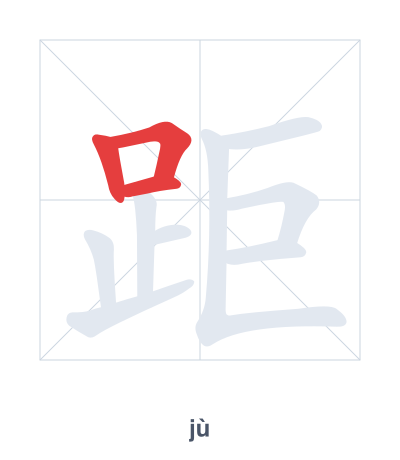
Open Hanzi Writer to see the animated stroke order and practice writing 距 with real-time feedback.
The character 距 (jù) is written with 11 strokes. Follow the standard Chinese stroke order: top to bottom, left to right, outside before inside. The radical 足 is one of its key components.
Practice the correct stroke order with the Hanzi Writer app to see animated stroke-by-stroke guidance with real-time feedback.
距 means distance.
As an HSK Level 4 character, 距 is an intermediate-level character.
The left side 足 means 'foot,' suggesting movement or stepping. The right side 巨 originally depicted a carpenter's square used for measuring, so together they imply measuring the space between steps—hence 'distance.'
💡 Memory Tip: Imagine a giant foot (足) stepping over a huge (巨) canyon to measure the vast distance.
学校距离家很近。
xué xiào jù lí jiā hěn jìn
The school is very close to home.
两人的成绩有差距。
liǎng rén de chéng jì yǒu chā jù
There is a gap between their grades.
请保持座位间距。
qǐng bǎo chí zuò wèi jiān jù
Please maintain seat spacing.
Open Hanzi Writer to see the animated stroke order and practice writing 距 with real-time feedback.
✨ Animated stroke order · Handwriting recognition · HSK-graded practice · Free to use
距 is composed of the radical 足 (foot) on the left and the component 巨 (jù) on the right. The foot radical suggests movement or measurement, while 巨 originally related to a tool for measuring, together forming the idea of measuring distance between points.