离 (lí) means "to leave; away from; to part" in Chinese. It has 10 strokes with the radical 禸, and is HSK Level 2.
Rated 3.7/5 in difficulty (challenging).
Harder than 88% of HSK Level 2 characters.
Appears in 3+ common words including 离开 (lí kāi), 距离 (jù lí), 离婚 (lí hūn).
Due to its 10 strokes, Hanzi Writer's error detection shows 离 requires focused practice — most learners need 10+ attempts for consistent accuracy.
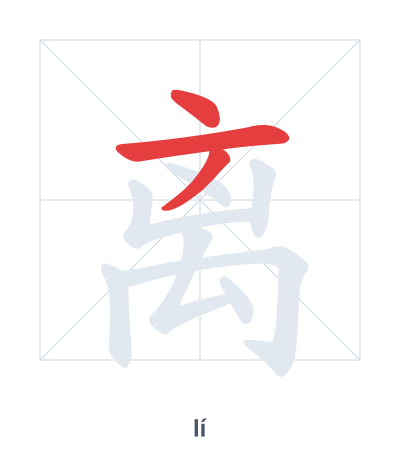
Open Hanzi Writer to see the animated stroke order and practice writing 离 with real-time feedback.
The character 离 (lí) is written with 10 strokes. Follow the standard Chinese stroke order: top to bottom, left to right, outside before inside. The radical 禸 is one of its key components.
Practice the correct stroke order with the Hanzi Writer app to see animated stroke-by-stroke guidance with real-time feedback.
离 means to leave; away from; to part.
As an HSK Level 2 character, 离 is among the first characters beginners learn.
The ancient form of 离 depicted a bird (possibly a magpie) with a prominent tail, but the character was later borrowed to mean 'to leave' due to phonetic similarity. The current structure includes the radical 禸 (animal track), reinforcing the idea of moving away or departing.
💡 Memory Tip: Picture a bird trapped under a roof (top) in a cage (middle) using its legs (bottom 禸) to kick open the bars and fly away—that's leaving.
他明天离开北京。
tā míng tiān lí kāi běi jīng
He is leaving Beijing tomorrow.
学校距离我家很近。
xué xiào jù lí wǒ jiā hěn jìn
The school is very close to my home.
他们去年离婚了。
tā men qù nián lí hūn le
They got divorced last year.
Open Hanzi Writer to see the animated stroke order and practice writing 离 with real-time feedback.
✨ Animated stroke order · Handwriting recognition · HSK-graded practice · Free to use
离 is made of three parts: the top radical 亠 (a lid), the middle 凶 (meaning danger), and the bottom 禸 (an animal track). Together, they suggest moving away from a dangerous place, which connects to the meaning 'to leave' or 'to depart.'