糊 (hú/hù) means "Paste" in Chinese. It has 15 strokes with the radical 米, and is HSK Level 5.
Rated 4.2/5 in difficulty (advanced).
Harder than 86% of HSK Level 5 characters.
Appears in 4+ common words including 糊涂 (hú tú), 糊弄 (hù nòng), 糊墙 (hú qiáng).
Due to its 15 strokes, Hanzi Writer's error detection shows 糊 requires focused practice — most learners need 10+ attempts for consistent accuracy.
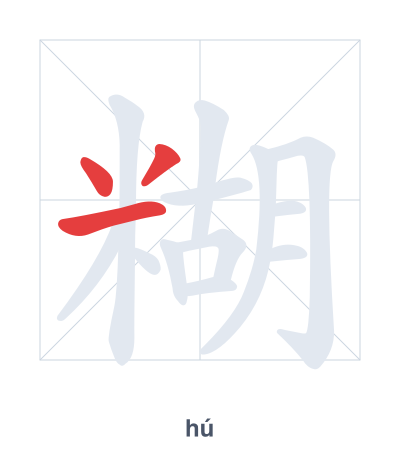
Open Hanzi Writer to see the animated stroke order and practice writing 糊 with real-time feedback.
The character 糊 (hú/hù) is written with 15 strokes. Follow the standard Chinese stroke order: top to bottom, left to right, outside before inside. The radical 米 is one of its key components.
Practice the correct stroke order with the Hanzi Writer app to see animated stroke-by-stroke guidance with real-time feedback.
糊 means Paste.
This is a polyphonic character with readings: hú, hù.
As an HSK Level 5 character, 糊 is an intermediate-level character.
糊 is a phono-semantic compound where 米 (rice) on the left represents the key ingredient for making paste, while 胡 (hú) on the right gives the sound. Rice flour mixed with water creates a sticky paste used as adhesive or food thickener.
💡 Memory Tip: Picture a rice (米) beard (胡) that is so sticky with paste it clumps together like glue.
他人老了,有些事情记不清楚,变得糊涂了。
tā rén lǎo le yǒu xiē shì qíng jì bù qīng chǔ biàn dé hú tú le
He is old now; he can't remember some things clearly and has become muddled.
做事要踏踏实实,千万不能应付糊弄。
zuò shì yào tà tà shí shí qiān wàn bù néng yìng fù hù nòng
You should do things in a down-to-earth manner and never just go through the motions or be sloppy.
装修工正在用精美的壁纸为卧室糊墙。
zhuāng xiū gōng zhèng zài yòng jīng měi de bì zhǐ wèi wò shì hú qiáng
The renovator is papering the bedroom walls with exquisite wallpaper.
他的脸上糊满了泥土,样子非常滑稽。
tā de liǎn shàng hú mǎn le ní tǔ yàng zi fēi cháng huá jī
His face was covered in mud, and he looked very comical.
Open Hanzi Writer to see the animated stroke order and practice writing 糊 with real-time feedback.
✨ Animated stroke order · Handwriting recognition · HSK-graded practice · Free to use
糊 is made of two parts: the left radical 米 (rice) and the right part 胡 (hú, which gives the sound). Rice is used to make paste or glue, so the character combines "rice" with a phonetic component to mean "paste" or "sticky mixture."