粲 (càn) means "Bright; clear; fine rice." in Chinese. It has 13 strokes with the radical 米.
Rated 4.2/5 in difficulty (advanced).
Appears in 3+ common words including 粲然 (càn rán), 粲烂 (càn làn), 粲粲 (càn càn).
Due to its 13 strokes, Hanzi Writer's error detection shows 粲 requires focused practice — most learners need 10+ attempts for consistent accuracy.
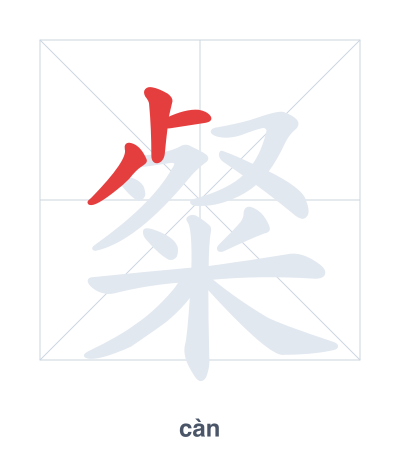
Open Hanzi Writer to see the animated stroke order and practice writing 粲 with real-time feedback.
The character 粲 (càn) is written with 13 strokes. Follow the standard Chinese stroke order: top to bottom, left to right, outside before inside. The radical 米 is one of its key components.
Practice the correct stroke order with the Hanzi Writer app to see animated stroke-by-stroke guidance with real-time feedback.
粲 means Bright; clear; fine rice..
粲 combines 米 (rice) with 㐭 (a granary or roofed shelter). The original meaning was fine, polished rice, which was so clean and glossy that it came to mean 'bright' or 'clear.' The character visually suggests rice stored under a roof, kept pristine and shining.
💡 Memory Tip: Picture a granary roof (㐭) over gleaming rice (米) that sparkles so brightly you can't look away—that's粲 (càn).
他粲然一笑。
tā càn rán yī xiào
He gave a bright smile.
星光粲烂。
xīng guāng càn làn
The starlight is magnificent and splendid.
鲜花粲粲。
xiān huā càn càn
The flowers are bright and beautiful.
Open Hanzi Writer to see the animated stroke order and practice writing 粲 with real-time feedback.
✨ Animated stroke order · Handwriting recognition · HSK-graded practice · Free to use
粲 is made of two parts: the left side is 米 (rice), and the right side is 㐭, a phonetic component that also hints at brightness. Together, 米 connects to the original meaning "fine rice," while the right part extends the idea to "bright" and "clear."