涂 (tú) means "to paint; to smear; to spread" in Chinese. It has 10 strokes with the radical 氵, and is HSK Level 7.
Rated 4.2/5 in difficulty (advanced).
Harder than 66% of HSK Level 7 characters.
Appears in 3+ common words including 糊涂 (hú tú), 涂改 (tú gǎi), 涂抹 (tú mǒ).
Due to its 10 strokes, Hanzi Writer's error detection shows 涂 requires focused practice — most learners need 10+ attempts for consistent accuracy.
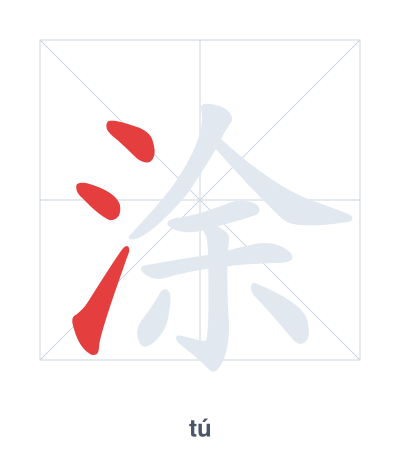
Open Hanzi Writer to see the animated stroke order and practice writing 涂 with real-time feedback.
The character 涂 (tú) is written with 10 strokes. Follow the standard Chinese stroke order: top to bottom, left to right, outside before inside. The radical 氵 is one of its key components.
Practice the correct stroke order with the Hanzi Writer app to see animated stroke-by-stroke guidance with real-time feedback.
涂 means to paint; to smear; to spread.
As an HSK Level 7 character, 涂 is an intermediate-level character.
涂 combines the water radical 氵 with the phonetic component 余 (yú, meaning 'surplus' or 'excess'). The original meaning was to apply liquid liberally, like spreading water or paint over a surface, hence 'to smear' or 'to coat'.
💡 Memory Tip: Picture a painter (氵) using a brush to smear a thick, leftover smear (余) of paint across a canvas.
他总是很糊涂。
tā zǒng shì hěn hú tú
He is always very muddled.
请不要涂改作业。
qǐng bú yào tú gǎi zuò yè
Please don't alter your homework.
她在脸上涂抹面霜。
tā zài liǎn shàng tú mǒ miàn shuāng
She is applying face cream.
Open Hanzi Writer to see the animated stroke order and practice writing 涂 with real-time feedback.
✨ Animated stroke order · Handwriting recognition · HSK-graded practice · Free to use
涂 is made of the water radical 氵 on the left and the character 余 (yú, meaning "surplus") on the right. The water radical connects to the act of smearing or painting, which often involves a liquid. The right side 余 provides pronunciation and hints at the idea of "spreading" something extra.