啡 (fēi) means "Coffee (morpheme)" in Chinese. It has 11 strokes with the radical 口, and is HSK Level 3.
Rated 4.2/5 in difficulty (advanced).
Harder than 70% of HSK Level 3 characters.
Appears in 3+ common words including 咖啡 (kā fēi), 咖啡店 (kā fēi diàn), 喝咖啡 (hē kā fēi).
Due to its 11 strokes, Hanzi Writer's error detection shows 啡 requires focused practice — most learners need 10+ attempts for consistent accuracy.
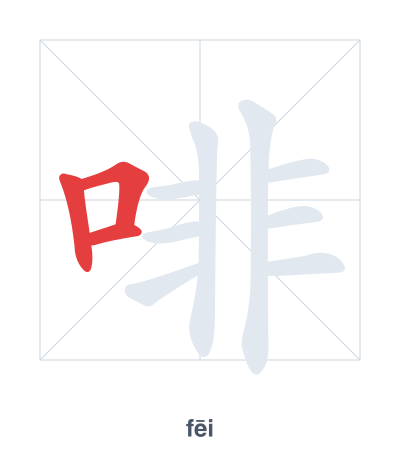
Open Hanzi Writer to see the animated stroke order and practice writing 啡 with real-time feedback.
The character 啡 (fēi) is written with 11 strokes. Follow the standard Chinese stroke order: top to bottom, left to right, outside before inside. The radical 口 is one of its key components.
Practice the correct stroke order with the Hanzi Writer app to see animated stroke-by-stroke guidance with real-time feedback.
啡 means Coffee (morpheme).
As an HSK Level 3 character, 啡 is an intermediate-level character.
啡 is a modern character created as a phonetic loan for 'coffee' from English. The radical 口 (mouth) hints at the act of drinking, while 非 (fēi) provides the sound.
💡 Memory Tip: Picture a mouth (口) saying 'fee' (non-standard sound of 非) while eagerly waiting for your coffee to cool.
我喜欢喝黑咖啡。
wǒ xǐ huān hē hēi kā fēi
I like drinking black coffee.
我们在咖啡店见面。
wǒ men zài kā fēi diàn jiàn miàn
We meet at the coffee shop.
你想喝咖啡吗?
nǐ xiǎng hē kā fēi ma
Do you want to drink coffee?
Open Hanzi Writer to see the animated stroke order and practice writing 啡 with real-time feedback.
✨ Animated stroke order · Handwriting recognition · HSK-graded practice · Free to use
啡 is a left-right character made of the radical 口 (mouth) on the left and 非 (fēi) on the right. The 口 suggests something related to drinking, and 非 provides the sound, so together they form a phono-semantic compound used in the word 咖啡 (coffee).