咖 (gā/kā) means "coffee; curry" in Chinese. It has 8 strokes with the radical 口, and is HSK Level 3.
Rated 3.7/5 in difficulty (challenging).
Harder than 47% of HSK Level 3 characters.
Appears in 2+ common words including 咖啡 (kā fēi), 咖喱 (gā lí).
Due to its 8 strokes, Hanzi Writer's error detection shows 咖 requires focused practice — most learners need 10+ attempts for consistent accuracy.
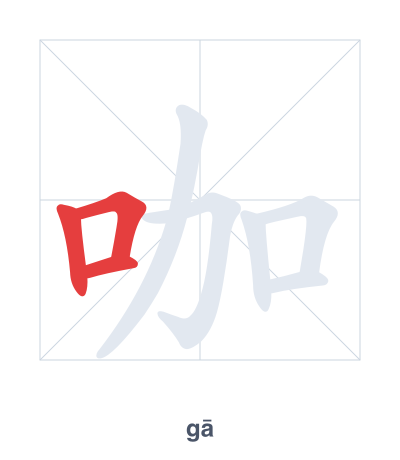
Open Hanzi Writer to see the animated stroke order and practice writing 咖 with real-time feedback.
The character 咖 (gā/kā) is written with 8 strokes. Follow the standard Chinese stroke order: top to bottom, left to right, outside before inside. The radical 口 is one of its key components.
Practice the correct stroke order with the Hanzi Writer app to see animated stroke-by-stroke guidance with real-time feedback.
咖 means coffee; curry.
This is a polyphonic character with readings: gā, kā.
As an HSK Level 3 character, 咖 is an intermediate-level character.
This compound character combines the mouth radical (口) with the phonetic component 加 (jiā, 'to add'). It was created to transcribe foreign words like coffee (咖啡 kāfēi) and curry (咖喱 gālí), where the mouth radical hints at eating or drinking.
💡 Memory Tip: Picture your mouth (口) adding (加) a heap of spicy curry powder, making you gasp 'Gā!' with the kick.
很多人习惯在早晨喝一杯热咖啡来提神。
hěn duō rén xí guàn zài zǎo chén hē yī bēi rè kā fēi lái tí shén
Many people are used to drinking a cup of hot coffee in the morning to refresh themselves.
东南亚餐厅里的咖喱牛肉味道非常正宗。
dōng nán yà cān tīng lǐ de gā lí niú ròu wèi dào fēi cháng zhèng zōng
The curry beef in the Southeast Asian restaurant tastes very authentic.
Open Hanzi Writer to see the animated stroke order and practice writing 咖 with real-time feedback.
✨ Animated stroke order · Handwriting recognition · HSK-graded practice · Free to use
咖 is made of the mouth radical 口 on the left and 加 (jiā, to add) on the right. The mouth radical hints that the character is related to eating or drinking, while 加 gives a phonetic clue to the pronunciation 'gā'. Together, they form a character used in foreign loanwords like coffee and curry.