筑 (zhù) means "To build; to construct; an ancient stringed instrument" in Chinese. It has 12 strokes with the radical ⺮, and is HSK Level 5.
Rated 4.2/5 in difficulty (advanced).
Harder than 85% of HSK Level 5 characters.
Appears in 3+ common words including 建筑 (jiàn zhù), 修筑 (xiū zhù), 筑巢 (zhù cháo).
Due to its 12 strokes, Hanzi Writer's error detection shows 筑 requires focused practice — most learners need 10+ attempts for consistent accuracy.
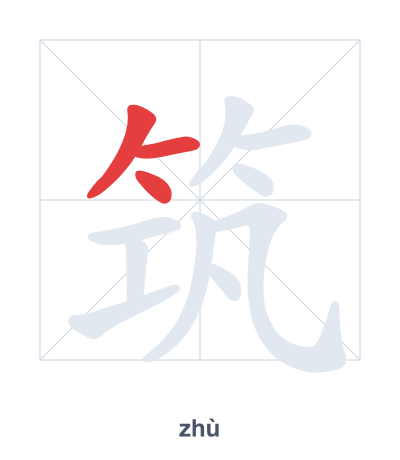
Open Hanzi Writer to see the animated stroke order and practice writing 筑 with real-time feedback.
The character 筑 (zhù) is written with 12 strokes. Follow the standard Chinese stroke order: top to bottom, left to right, outside before inside. The radical ⺮ is one of its key components.
Practice the correct stroke order with the Hanzi Writer app to see animated stroke-by-stroke guidance with real-time feedback.
筑 means To build; to construct; an ancient stringed instrument.
As an HSK Level 5 character, 筑 is an intermediate-level character.
筑 combines the bamboo radical ⺮ (bamboo) with 巩 (gǒng), which depicts hands working with a mallet on rammed earth. Originally it referred to a bamboo-stringed instrument, but later extended to mean 'to build,' as bamboo was used for scaffolding in construction.
💡 Memory Tip: Imagine a builder using bamboo poles (⺮) to secure a frame (like 巩) while constructing a house—bamboo builds!
这座建筑非常高。
zhè zuò jiàn zhù fēi cháng gāo
This building is very tall.
工人们在修筑铁路。
gōng rén men zài xiū zhù tiě lù
The workers are building a railway.
小鸟在树上筑巢。
xiǎo niǎo zài shù shàng zhù cháo
The little bird is building a nest in the tree.
Open Hanzi Writer to see the animated stroke order and practice writing 筑 with real-time feedback.
✨ Animated stroke order · Handwriting recognition · HSK-graded practice · Free to use
筑 has a bamboo radical (⺮) on top and 巩 (gǒng) below. The bamboo part hints at the ancient stringed instrument made from bamboo, while 巩 means 'to consolidate' and relates to the action of building firmly.