筛 (shāi) means "to sieve; to sift" in Chinese. It has 12 strokes with the radical ⺮, and is HSK Level 7.
Rated 4.2/5 in difficulty (advanced).
Harder than 79% of HSK Level 7 characters.
Appears in 3+ common words including 筛选 (shāi xuǎn), 筛子 (shāi zi), 筛沙 (shāi shā).
Due to its 12 strokes, Hanzi Writer's error detection shows 筛 requires focused practice — most learners need 10+ attempts for consistent accuracy.
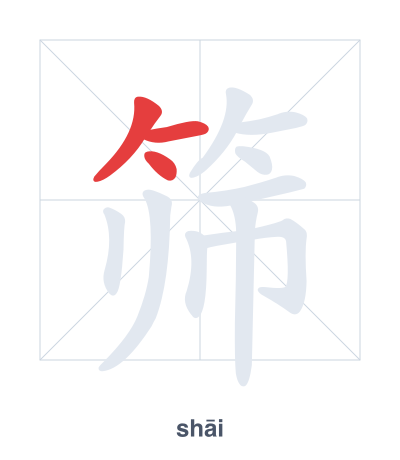
Open Hanzi Writer to see the animated stroke order and practice writing 筛 with real-time feedback.
The character 筛 (shāi) is written with 12 strokes. Follow the standard Chinese stroke order: top to bottom, left to right, outside before inside. The radical ⺮ is one of its key components.
Practice the correct stroke order with the Hanzi Writer app to see animated stroke-by-stroke guidance with real-time feedback.
筛 means to sieve; to sift.
As an HSK Level 7 character, 筛 is an intermediate-level character.
The character 筛 combines the bamboo radical ⺮, indicating the material used for making sieves, with 师 (shī), which originally provided the pronunciation. Ancient sieves were woven from thin bamboo strips, so the bamboo component visually connects to the meaning of sifting or filtering.
💡 Memory Tip: Imagine a teacher (师) using a bamboo (⺮) sieve to sift out the best students from the rest.
正在筛选名单。
zhèng zài shāi xuǎn míng dān
Currently screening the list.
拿一个筛子来。
ná yí gè shāi zi lái
Bring a sieve.
工人在筛沙子。
gōng rén zài shāi shā zi
The worker is screening sand.
Open Hanzi Writer to see the animated stroke order and practice writing 筛 with real-time feedback.
✨ Animated stroke order · Handwriting recognition · HSK-graded practice · Free to use
筛 consists of the bamboo radical ⺮ on top and the character 师 (shī, teacher) below. Bamboo is used to make traditional sieves, and the phonetic part 师 gives a clue to the pronunciation (shāi), while the meaning comes from the bamboo material.