答 (dā/dá) means "To answer; to reply" in Chinese. It has 12 strokes with the radical ⺮, and is HSK Level 1.
Rated 3.7/5 in difficulty (challenging).
Harder than 95% of HSK Level 1 characters.
Appears in 4+ common words including 回答 (huí dá), 报答 (bào dá), 答应 (dā yìng).
Due to its 12 strokes, Hanzi Writer's error detection shows 答 requires focused practice — most learners need 10+ attempts for consistent accuracy.
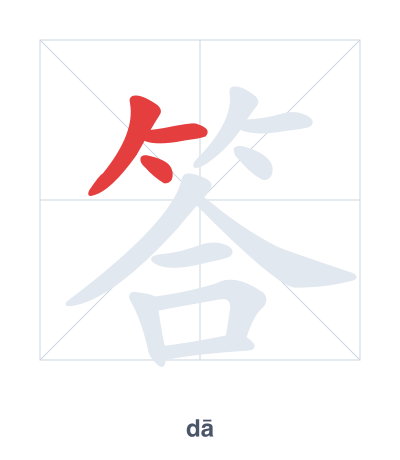
Open Hanzi Writer to see the animated stroke order and practice writing 答 with real-time feedback.
The character 答 (dā/dá) is written with 12 strokes. Follow the standard Chinese stroke order: top to bottom, left to right, outside before inside. The radical ⺮ is one of its key components.
Practice the correct stroke order with the Hanzi Writer app to see animated stroke-by-stroke guidance with real-time feedback.
答 means To answer; to reply.
This is a polyphonic character with readings: dā, dá.
As an HSK Level 1 character, 答 is among the first characters beginners learn.
答 combines the bamboo radical (⺮) with 合 (to combine, fit). Since ancient bamboo slips were used for writing replies, the character suggests a written response that 'fits' the question.
💡 Memory Tip: Imagine a bamboo shoot (⺮) answering a question by joining (合) two pieces of bamboo together.
请针对老师提出的问题做出准确的回答。
qǐng zhēn duì lǎo shī tí chū de wèn tí zuò chū zhǔn què de huí dá
Please provide an accurate answer to the question raised by the teacher.
我们要努力学习,以优异成绩报答父母。
wǒ men yào nǔ lì xué xí yǐ yōu yì chéng jì bào dá fù mǔ
We must study hard to repay our parents with excellent grades.
既然你已经答应了人家,就一定要做到。
jì rán nǐ yǐ jīng dā yìng le rén jiā jiù yí dìng yào zuò dào
Since you have promised them, you must follow through.
他最近心情不好,谁跟他说话他都不答理。
tā zuì jìn xīn qíng bù hǎo shuí gēn tā shuō huà tā dōu bù dā lǐ
He's been in a bad mood lately and ignores anyone who talks to him.
Open Hanzi Writer to see the animated stroke order and practice writing 答 with real-time feedback.
✨ Animated stroke order · Handwriting recognition · HSK-graded practice · Free to use
答 is made of two parts: the top radical ⺮ (bamboo) and the bottom part 合 (hé, to combine). In ancient China, answers were often written on bamboo slips, so the bamboo top connects to writing. The bottom 合 suggests combining a question and an answer together.