第 (dì) means "prefix for ordinal numbers" in Chinese. It has 11 strokes with the radical ⺮, and is HSK Level 1.
Rated 3.7/5 in difficulty (challenging).
Harder than 94% of HSK Level 1 characters.
Appears in 3+ common words including 第一 (dì yī), 第二次 (dì èr cì), 第一个 (dì yí gè).
Due to its 11 strokes, Hanzi Writer's error detection shows 第 requires focused practice — most learners need 10+ attempts for consistent accuracy.
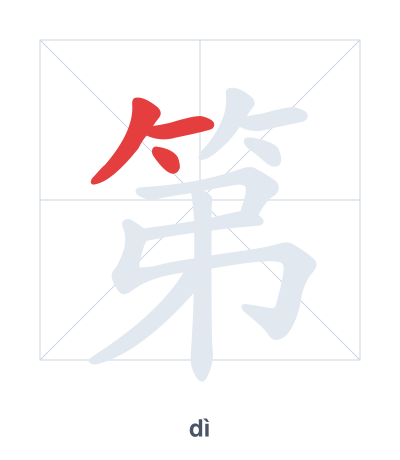
Open Hanzi Writer to see the animated stroke order and practice writing 第 with real-time feedback.
The character 第 (dì) is written with 11 strokes. Follow the standard Chinese stroke order: top to bottom, left to right, outside before inside. The radical ⺮ is one of its key components.
Practice the correct stroke order with the Hanzi Writer app to see animated stroke-by-stroke guidance with real-time feedback.
第 means prefix for ordinal numbers.
As an HSK Level 1 character, 第 is among the first characters beginners learn.
第 originally combined bamboo (⺮), referencing bamboo slips used for recording sequences, with 弟 (dì, 'younger brother') for sound and the idea of hierarchical order. Over time, it specialized as the prefix for ordinal numbers, marking position in a series.
💡 Memory Tip: Picture a younger brother (弟) using bamboo strips (⺮) to mark his rank as first in an orderly line.
他是班里的第一名。
tā shì bān lǐ de dì yì míng
He is the first in the class.
这是我第二次来北京。
zhè shì wǒ dì èr cì lái běi jīng
This is my second time visiting Beijing.
我是第一个到教室的。
wǒ shì dì yí gè dào jiào shì de
I was the first one to arrive at the classroom.
Open Hanzi Writer to see the animated stroke order and practice writing 第 with real-time feedback.
✨ Animated stroke order · Handwriting recognition · HSK-graded practice · Free to use
第 is made of the radical ⺮ (bamboo) on top and the character 弟 (younger brother) on the bottom. In ancient China, bamboo strips were numbered in order, so the bamboo radical gives the idea of sequencing, while 弟 provides the sound. Together they create the meaning of an ordinal number prefix.