笔 (bǐ) means "Pen, pencil, or brush" in Chinese. It has 10 strokes with the radical ⺮, and is HSK Level 2.
Rated 3.7/5 in difficulty (challenging).
Harder than 89% of HSK Level 2 characters.
Appears in 3+ common words including 铅笔 (qiān bǐ), 笔记 (bǐ jì), 毛笔 (máo bǐ).
Due to its 10 strokes, Hanzi Writer's error detection shows 笔 requires focused practice — most learners need 10+ attempts for consistent accuracy.
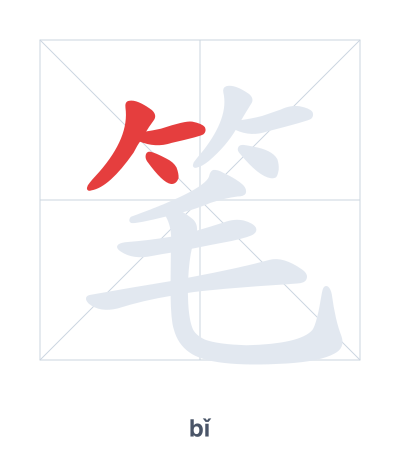
Open Hanzi Writer to see the animated stroke order and practice writing 笔 with real-time feedback.
The character 笔 (bǐ) is written with 10 strokes. Follow the standard Chinese stroke order: top to bottom, left to right, outside before inside. The radical ⺮ is one of its key components.
Practice the correct stroke order with the Hanzi Writer app to see animated stroke-by-stroke guidance with real-time feedback.
笔 means Pen, pencil, or brush.
As an HSK Level 2 character, 笔 is among the first characters beginners learn.
笔 combines ⺮ (bamboo, the handle) and 毛 (hair/fur, the tip), reflecting ancient Chinese brushes made from a bamboo shaft with animal hair. This compound character visually represents the essential materials of a traditional writing implement.
💡 Memory Tip: Picture a bamboo stalk (⺮) sprouting a tuft of fur (毛) at its tip—that's your brush ready to write!
我有一支铅笔。
wǒ yǒu yī zhī qiān bǐ
I have a pencil.
他在做笔记。
tā zài zuò bǐ jì
He is taking notes.
我学习写毛笔字。
wǒ xué xí xiě máo bǐ zì
I'm learning calligraphy.
Open Hanzi Writer to see the animated stroke order and practice writing 笔 with real-time feedback.
✨ Animated stroke order · Handwriting recognition · HSK-graded practice · Free to use
笔 is made of the bamboo radical ⺮ on top and the character 毛 (hair or fur) below. Bamboo was used for pen handles, and animal hair for brush tips, so together they represent a writing instrument like a pen or brush.