笑 (xiào) means "To laugh or smile" in Chinese. It has 10 strokes with the radical ⺮, and is HSK Level 1.
Rated 3.7/5 in difficulty (challenging).
Harder than 94% of HSK Level 1 characters.
Appears in 3+ common words including 玩笑 (wán xiào), 微笑 (wēi xiào), 笑容 (xiào róng).
Due to its 10 strokes, Hanzi Writer's error detection shows 笑 requires focused practice — most learners need 10+ attempts for consistent accuracy.
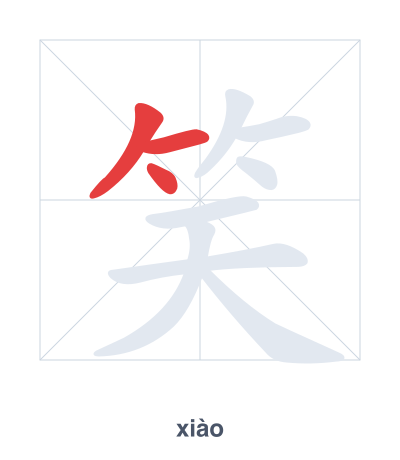
Open Hanzi Writer to see the animated stroke order and practice writing 笑 with real-time feedback.
The character 笑 (xiào) is written with 10 strokes. Follow the standard Chinese stroke order: top to bottom, left to right, outside before inside. The radical ⺮ is one of its key components.
Practice the correct stroke order with the Hanzi Writer app to see animated stroke-by-stroke guidance with real-time feedback.
笑 means To laugh or smile.
As an HSK Level 1 character, 笑 is among the first characters beginners learn.
The character 笑 combines ⺮ (bamboo) with 夭 (a person bending or swaying), evoking the image of bamboo stalks bending in the wind—a metaphor for the body bending or shaking with laughter.
💡 Memory Tip: Imagine a person (夭) wearing a bamboo hat (⺮) who laughs so hard they bend over, with the hat flopping up and down.
别开玩笑了。
bié kāi wán xiào le
Stop joking around.
她在对我微笑。
tā zài duì wǒ wēi xiào
She is smiling at me.
他的笑容很美。
tā de xiào róng hěn měi
His smile is very beautiful.
Open Hanzi Writer to see the animated stroke order and practice writing 笑 with real-time feedback.
✨ Animated stroke order · Handwriting recognition · HSK-graded practice · Free to use
笑 is composed of the bamboo radical (⺮) on top and the component 夭 (yāo) below. The bamboo leaves can be imagined as curved eyebrows and a smile, while 夭 suggests a person bending over in laughter. Together, they create the idea of a smiling or laughing person.