筋 (jīn) means "Muscle; tendon; vein" in Chinese. It has 12 strokes with the radical ⺮, and is HSK Level 7.
Rated 4.2/5 in difficulty (advanced).
Harder than 78% of HSK Level 7 characters.
Appears in 3+ common words including 脑筋 (nǎo jīn), 抽筋 (chōu jīn), 面筋 (miàn jīn).
Due to its 12 strokes, Hanzi Writer's error detection shows 筋 requires focused practice — most learners need 10+ attempts for consistent accuracy.
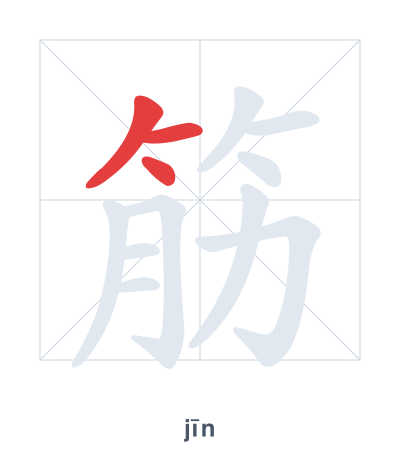
Open Hanzi Writer to see the animated stroke order and practice writing 筋 with real-time feedback.
The character 筋 (jīn) is written with 12 strokes. Follow the standard Chinese stroke order: top to bottom, left to right, outside before inside. The radical ⺮ is one of its key components.
Practice the correct stroke order with the Hanzi Writer app to see animated stroke-by-stroke guidance with real-time feedback.
筋 means Muscle; tendon; vein.
As an HSK Level 7 character, 筋 is an intermediate-level character.
The character 筋 combines bamboo (⺮) as a semantic hint for fibrous, stringy structures, and flesh (⺼/肉) to indicate body tissue. Together they depict the sinewy fibers running through meat, representing tendons and muscles.
💡 Memory Tip: Picture a bamboo tube (⺮) filled with raw meat (⺼) that you have to stretch like a rubber band — that's your tough tendon.
动动脑筋想办法。
dòng dòng nǎo jīn xiǎng bàn fǎ
Use your head to find a way.
我的腿突然抽筋了。
wǒ de tuǐ tū rán chōu jīn le
My leg suddenly cramped.
我喜欢吃炒面筋。
wǒ xǐ huān chī chǎo miàn jīn
I like eating stir-fried wheat gluten.
Open Hanzi Writer to see the animated stroke order and practice writing 筋 with real-time feedback.
✨ Animated stroke order · Handwriting recognition · HSK-graded practice · Free to use
筋 is composed of three parts: the top is 竹 (bamboo), the bottom left is 肉 (flesh/meat), and the bottom right is 力 (strength). Together, they suggest that muscles and tendons are like strong fibers (bamboo) inside your flesh that give you strength.