巢 (cháo) means "Nest" in Chinese. It has 11 strokes with the radical 巛, and is HSK Level 7.
Rated 3.8/5 in difficulty (challenging).
Harder than 32% of HSK Level 7 characters.
Appears in 3+ common words including 鸟巢 (niǎo cháo), 筑巢 (zhù cháo), 归巢 (guī cháo).
Due to its 11 strokes, Hanzi Writer's error detection shows 巢 requires focused practice — most learners need 10+ attempts for consistent accuracy.
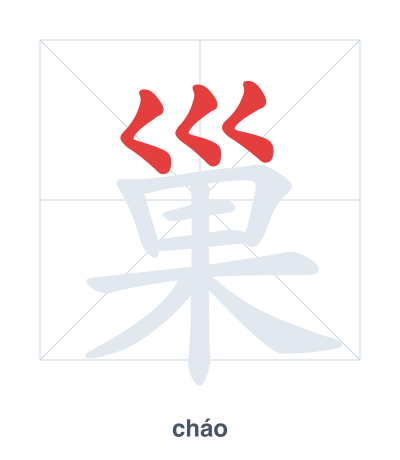
Open Hanzi Writer to see the animated stroke order and practice writing 巢 with real-time feedback.
The character 巢 (cháo) is written with 11 strokes. Follow the standard Chinese stroke order: top to bottom, left to right, outside before inside. The radical 巛 is one of its key components.
Practice the correct stroke order with the Hanzi Writer app to see animated stroke-by-stroke guidance with real-time feedback.
巢 means Nest.
As an HSK Level 7 character, 巢 is an intermediate-level character.
Originally a pictograph of a bird's nest in a tree, the top part (巛) depicts twigs or branches woven together, the middle (曰) represents the nest cavity, and the bottom (木) is the tree. Over time, the shape simplified to its current form.
💡 Memory Tip: Picture a tree (木) with a round nest (曰) woven from three bent twigs (巛) — that's a bird's cozy 巢 (cháo).
树上有一个鸟巢。
shù shàng yǒu yí gè niǎo cháo
There is a bird's nest in the tree.
小鸟正在筑巢。
xiǎo niǎo zhèng zài zhù cháo
The little bird is building a nest.
鸟儿已经归巢了。
niǎo ér yǐ jīng guī cháo le
The bird has returned to its nest.
Open Hanzi Writer to see the animated stroke order and practice writing 巢 with real-time feedback.
✨ Animated stroke order · Handwriting recognition · HSK-graded practice · Free to use
The character 巢 is made of three parts: the top 巛 (three short strokes) represents twigs or winding vines, the middle 曰 suggests the round opening of the nest, and the bottom 木 means tree. Together they picture a bird's nest built in a tree, which directly gives the meaning 'nest'.