笨 (bèn) means "stupid or clumsy" in Chinese. It has 11 strokes with the radical ⺮, and is HSK Level 4.
Rated 4.2/5 in difficulty (advanced).
Harder than 84% of HSK Level 4 characters.
Appears in 3+ common words including 笨蛋 (bèn dàn), 笨重 (bèn zhòng), 笨手笨脚 (bèn shǒu bèn jiǎo).
Due to its 11 strokes, Hanzi Writer's error detection shows 笨 requires focused practice — most learners need 10+ attempts for consistent accuracy.
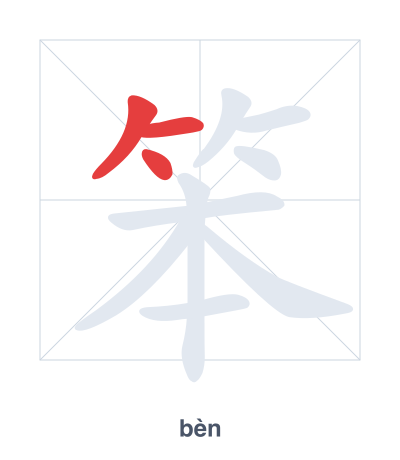
Open Hanzi Writer to see the animated stroke order and practice writing 笨 with real-time feedback.
The character 笨 (bèn) is written with 11 strokes. Follow the standard Chinese stroke order: top to bottom, left to right, outside before inside. The radical ⺮ is one of its key components.
Practice the correct stroke order with the Hanzi Writer app to see animated stroke-by-stroke guidance with real-time feedback.
笨 means stupid or clumsy.
As an HSK Level 4 character, 笨 is an intermediate-level character.
笨 originally described the inner, coarse layer of bamboo, which is thick and clumsy. Its components are the 'bamboo' radical (⺮) and 'root/base' (本), suggesting something basic and unrefined. Over time, it came to mean 'stupid' or 'clumsy' by association with roughness and lack of refinement.
💡 Memory Tip: Picture a bamboo plant (⺮) with such thick, clumsy roots (本) that it keeps tripping over itself, making it seem stupid.
他不是笨蛋。
tā bú shì bèn dàn
He is not a fool.
这个箱子很笨重。
zhè ge xiāng zi hěn bèn zhòng
This box is very bulky.
他干活笨手笨脚。
tā gàn huó bèn shǒu bèn jiǎo
He is clumsy at his work.
Open Hanzi Writer to see the animated stroke order and practice writing 笨 with real-time feedback.
✨ Animated stroke order · Handwriting recognition · HSK-graded practice · Free to use
The character 笨 has the bamboo radical ⺮ on top and 本 (běn, 'root') below. Historically, it referred to the inner layer of bamboo, but today it means stupid or clumsy. The bottom part 本 gives a hint to the pronunciation (bèn).