修 (xiū) means "to repair, study, or trim" in Chinese. It has 9 strokes with the radical 亻, and is HSK Level 3.
Rated 3.7/5 in difficulty (challenging).
Harder than 46% of HSK Level 3 characters.
Appears in 3+ common words including 修理 (xiū lǐ), 装修 (zhuāng xiū), 修改 (xiū gǎi).
Due to its 9 strokes, Hanzi Writer's error detection shows 修 requires focused practice — most learners need 10+ attempts for consistent accuracy.
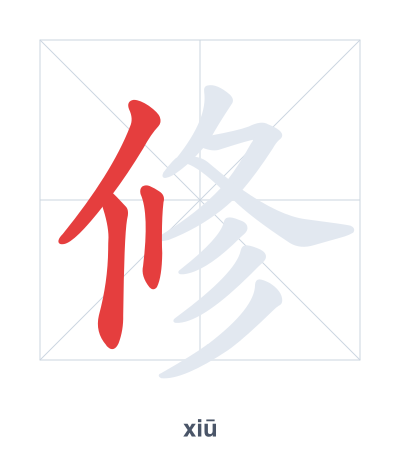
Open Hanzi Writer to see the animated stroke order and practice writing 修 with real-time feedback.
The character 修 (xiū) is written with 9 strokes. Follow the standard Chinese stroke order: top to bottom, left to right, outside before inside. The radical 亻 is one of its key components.
Practice the correct stroke order with the Hanzi Writer app to see animated stroke-by-stroke guidance with real-time feedback.
修 means to repair, study, or trim.
As an HSK Level 3 character, 修 is an intermediate-level character.
The character 修 combines the person radical 亻 with 攸, an ancient component that shows a hand holding a stick or brush, originally meaning to decorate or trim. Together, they depict a person carefully working to make something neat, leading to the meanings 'to repair', 'to study', and 'to trim'.
💡 Memory Tip: Picture a person (亻) using a brush (the right side 攸 looks like a hand with a tool) to carefully paint over cracks in a wall—that's repairing and studying the details.
我要去修理电脑。
wǒ yào qù xiū lǐ diàn nǎo
I'm going to get my computer repaired.
新房子正在装修。
xīn fáng zi zhèng zài zhuāng xiū
The new house is being renovated.
请修改一下这篇文章。
qǐng xiū gǎi yī xià zhè piān wén zhāng
Please revise this article.
Open Hanzi Writer to see the animated stroke order and practice writing 修 with real-time feedback.
✨ Animated stroke order · Handwriting recognition · HSK-graded practice · Free to use
修 is composed of two parts: the radical 亻 (person) on the left, and the phonetic component 攸 on the right. The person radical hints that the actions are done by people, like repairing or studying, while 攸 gives the sound xiū.