音 (yīn) means "sound; tone; music" in Chinese. It has 9 strokes with the radical 音, and is HSK Level 2.
Rated 2.8/5 in difficulty (moderate).
Harder than 32% of HSK Level 2 characters.
Appears in 3+ common words including 音乐 (yīn yuè), 声音 (shēng yīn), 发音 (fā yīn).
Hanzi Writer's stroke validation shows learners typically need 5-8 attempts to write 音 with correct proportion and order.
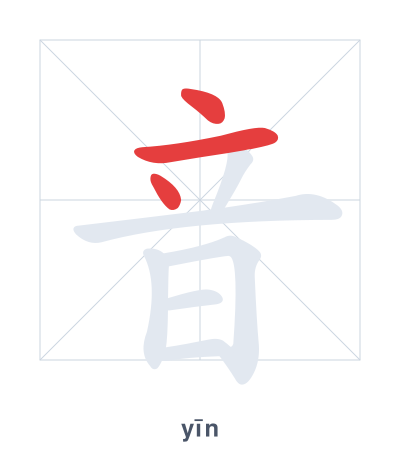
Open Hanzi Writer to see the animated stroke order and practice writing 音 with real-time feedback.
The character 音 (yīn) is written with 9 strokes. Follow the standard Chinese stroke order: top to bottom, left to right, outside before inside. The radical 音 is one of its key components.
Practice the correct stroke order with the Hanzi Writer app to see animated stroke-by-stroke guidance with real-time feedback.
音 means sound; tone; music.
As an HSK Level 2 character, 音 is among the first characters beginners learn.
音 was originally a pictograph that evolved from the character 言 (speech), with an added mark to indicate sound emanating from the mouth. In ancient forms, it depicted a tongue (言) with a dot or line representing vocal sound, symbolizing tone or music. Over time, the shape simplified into 立 (stand) above 日 (sun) in modern script, though its core meaning remains connected to audible sound.
💡 Memory Tip: Imagine the sun (日) standing up (立) to sing a loud sound, filling the sky with music.
我喜欢听音乐。
wǒ xǐ huān tīng yīn yuè
I like listening to music.
你的声音很好听。
nǐ de shēng yīn hěn hǎo tīng
Your voice sounds very nice.
他的发音很标准。
tā de fā yīn hěn biāo zhǔn
His pronunciation is very standard.
Open Hanzi Writer to see the animated stroke order and practice writing 音 with real-time feedback.
✨ Animated stroke order · Handwriting recognition · HSK-graded practice · Free to use
The character 音 is composed of two parts: the top part 立 (standing) and the bottom part 日 (sun/day). Together, they suggest sound standing under the sun, but historically it represents a tongue (言 variant) and a mouth, indicating sound produced by speech.