瘾 (yǐn) means "addiction or craving" in Chinese. It has 16 strokes with the radical 疒, and is HSK Level 7.
Rated 4.2/5 in difficulty (advanced).
Harder than 73% of HSK Level 7 characters.
Appears in 3+ common words including 上瘾 (shàng yǐn), 烟瘾 (yān yǐn), 过瘾 (guò yǐn).
Due to its 16 strokes, Hanzi Writer's error detection shows 瘾 requires focused practice — most learners need 10+ attempts for consistent accuracy.
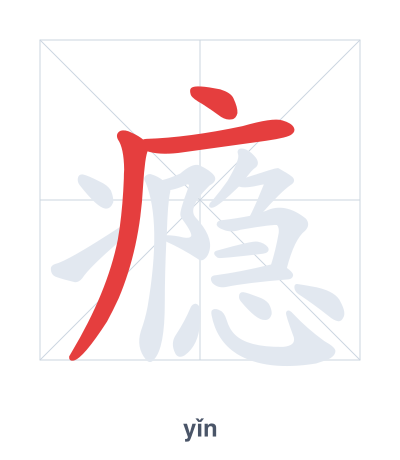
Open Hanzi Writer to see the animated stroke order and practice writing 瘾 with real-time feedback.
The character 瘾 (yǐn) is written with 16 strokes. Follow the standard Chinese stroke order: top to bottom, left to right, outside before inside. The radical 疒 is one of its key components.
Practice the correct stroke order with the Hanzi Writer app to see animated stroke-by-stroke guidance with real-time feedback.
瘾 means addiction or craving.
As an HSK Level 7 character, 瘾 is an intermediate-level character.
The character 瘾 combines the radical 疒 (illness) with 隐 (hidden/secret), indicating that addiction is a hidden or secretive illness. This phono-semantic compound reflects how a craving can be a concealed pathological condition.
💡 Memory Tip: Picture a sick person (疒) secretly hiding (隐) an uncontrollable craving under the covers.
他玩游戏上瘾了。
tā wán yóu xì shàng yǐn le
He is addicted to playing games.
他的烟瘾很大。
tā de yān yǐn hěn dà
He is a heavy smoker.
这顿饭吃得真过瘾。
zhè dùn fàn chī dé zhēn guò yǐn
This meal was really satisfying.
Open Hanzi Writer to see the animated stroke order and practice writing 瘾 with real-time feedback.
✨ Animated stroke order · Handwriting recognition · HSK-graded practice · Free to use
The character 瘾 has the sickness radical 疒 on the left, showing that addiction is like an illness. The right part 隐 (yǐn, meaning hidden) suggests that cravings can be hidden inside a person. Together, they convey the idea of a hidden disease or compulsive desire.