瘌 (là) means "favus; scalp disease" in Chinese. It has 14 strokes with the radical 疒.
Rated 4.2/5 in difficulty (advanced).
Appears in 3+ common words including 瘌痢 (là lì), 瘌痢头 (là lì tóu), 瘌蛤蟆 (là há ma).
Due to its 14 strokes, Hanzi Writer's error detection shows 瘌 requires focused practice — most learners need 10+ attempts for consistent accuracy.
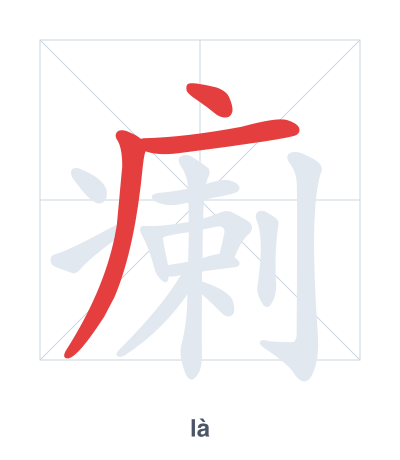
Open Hanzi Writer to see the animated stroke order and practice writing 瘌 with real-time feedback.
The character 瘌 (là) is written with 14 strokes. Follow the standard Chinese stroke order: top to bottom, left to right, outside before inside. The radical 疒 is one of its key components.
Practice the correct stroke order with the Hanzi Writer app to see animated stroke-by-stroke guidance with real-time feedback.
瘌 means favus; scalp disease.
The character 瘌 combines the sickness radical 疒 (illness) with the phonetic component 剌 (là, meaning 'to slash' or 'sharp'), suggesting a skin disease that causes sharp, irritating sores on the scalp. It specifically refers to favus, a fungal infection that leaves crusty, cutting-like lesions.
💡 Memory Tip: Imagine a sick scalp (疒) being slashed by a sharp knife (剌), causing raw, crusty wounds—that's favus.
他小时候得过瘌痢。
tā xiǎo shí hòu dé guò là lì
He had a scalp infection when he was a child.
那个小孩是个瘌痢头。
nà ge xiǎo hái shì gè là lì tóu
That child has a scald head.
地上有一只瘌蛤蟆。
dì shàng yǒu yī zhī là há ma
There is a toad on the ground.
Open Hanzi Writer to see the animated stroke order and practice writing 瘌 with real-time feedback.
✨ Animated stroke order · Handwriting recognition · HSK-graded practice · Free to use
The left part 疒 is the radical for illness or disease, showing this character is about a medical condition. The right part 剌 (là) provides the pronunciation and suggests irritation or stinging, matching the itchy scalp of favus.