瘊 (hóu) means "wart" in Chinese. It has 14 strokes with the radical 疒.
Rated 4.2/5 in difficulty (advanced).
Appears in 3+ common words including 瘊子 (hóu zi), 刺瘊 (cì hóu), 寻常瘊 (xún cháng hóu).
Due to its 14 strokes, Hanzi Writer's error detection shows 瘊 requires focused practice — most learners need 10+ attempts for consistent accuracy.
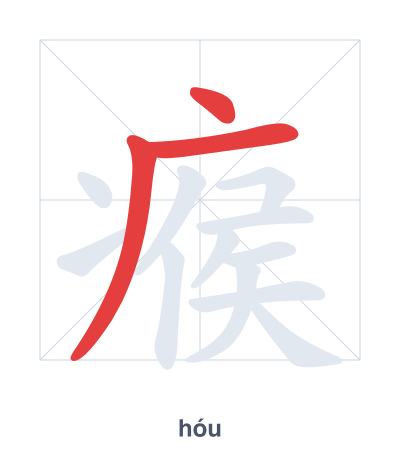
Open Hanzi Writer to see the animated stroke order and practice writing 瘊 with real-time feedback.
The character 瘊 (hóu) is written with 14 strokes. Follow the standard Chinese stroke order: top to bottom, left to right, outside before inside. The radical 疒 is one of its key components.
Practice the correct stroke order with the Hanzi Writer app to see animated stroke-by-stroke guidance with real-time feedback.
瘊 means wart.
瘊 is a phono-semantic compound combining the radical 疒 (illness, sickness) with the phonetic component 侯 (hóu, meaning 'marquis' or 'target'), indicating a type of skin growth or wart. The illness radical places it among diseases, while the phonetic gives its pronunciation and subtly hints at an ancient practice of using a target-like mark for warts.
💡 Memory Tip: Picture a sick bed (疒) holding a marquis (侯) whose face is covered in tiny target-shaped warts.
他手上长了一个瘊子。
tā shǒu shàng zhǎng le yí gè hóu zi
He has a wart on his hand.
这种刺瘊很难看。
zhè zhǒng cì hóu hěn nán kàn
This kind of wart is very ugly.
这是常见的寻常瘊。
zhè shì cháng jiàn de xún cháng hóu
This is a common wart.
Open Hanzi Writer to see the animated stroke order and practice writing 瘊 with real-time feedback.
✨ Animated stroke order · Handwriting recognition · HSK-graded practice · Free to use
The character 瘊 is made of the radical 疒 (illness) on the left and 侯 (hóu, marquis) on the right. The radical 疒 indicates it relates to a skin condition or disease, and 侯 gives the pronunciation. Together, they form the word for "wart."