愁 (chóu) means "to worry" in Chinese. It has 13 strokes with the radical 心, and is HSK Level 5.
Rated 4.2/5 in difficulty (advanced).
Harder than 68% of HSK Level 5 characters.
Appears in 3+ common words including 发愁 (fā chóu), 忧愁 (yōu chóu), 愁眉苦脸 (chóu méi kǔ liǎn).
Due to its 13 strokes, Hanzi Writer's error detection shows 愁 requires focused practice — most learners need 10+ attempts for consistent accuracy.
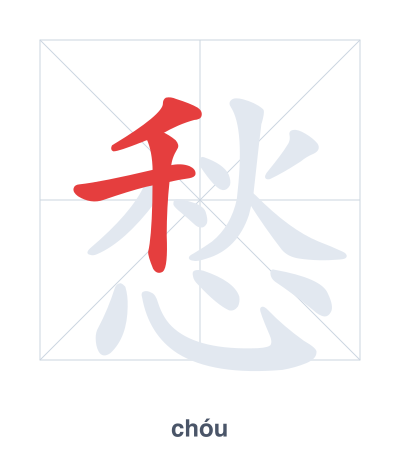
Open Hanzi Writer to see the animated stroke order and practice writing 愁 with real-time feedback.
The character 愁 (chóu) is written with 13 strokes. Follow the standard Chinese stroke order: top to bottom, left to right, outside before inside. The radical 心 is one of its key components.
Practice the correct stroke order with the Hanzi Writer app to see animated stroke-by-stroke guidance with real-time feedback.
愁 means to worry.
As an HSK Level 5 character, 愁 is an intermediate-level character.
愁 is a compound character combining 秋 (autumn) and 心 (heart). Autumn is traditionally a season of melancholy and decline, so the heart experiencing autumn conveys the feeling of worry or sadness.
💡 Memory Tip: Picture a heart (心) sitting under a pile of falling autumn leaves (秋), feeling burdened and worried.
别为考试发愁。
bié wèi kǎo shì fā chóu
Don't worry about the exam.
他脸上带着忧愁。
tā liǎn shàng dài zhe yōu chóu
He has a look of sadness on his face.
你为什么愁眉苦脸的?
nǐ wèi shén me chóu méi kǔ liǎn de
Why the long face?
Open Hanzi Writer to see the animated stroke order and practice writing 愁 with real-time feedback.
✨ Animated stroke order · Handwriting recognition · HSK-graded practice · Free to use
愁 is composed of 秋 (autumn, chōu) on top and 心 (heart, xīn) at the bottom. Autumn is often associated with a feeling of melancholy or decline, and the heart represents emotion. Together, they suggest a heart filled with worry, like the sadness that autumn can bring.