愆 (qiān) means "fault" in Chinese. It has 13 strokes with the radical 心.
Rated 4.2/5 in difficulty (advanced).
Appears in 3+ common words including 愆期 (qiān qī), 罪愆 (zuì qiān), 愆尤 (qiān yóu).
Due to its 13 strokes, Hanzi Writer's error detection shows 愆 requires focused practice — most learners need 10+ attempts for consistent accuracy.
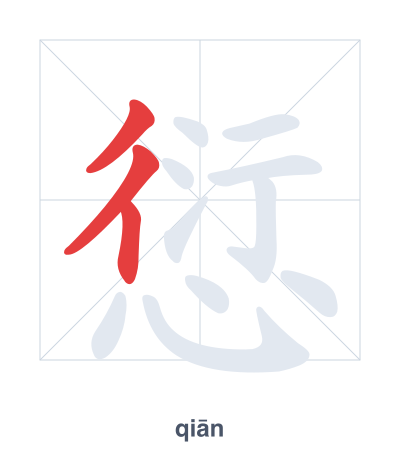
Open Hanzi Writer to see the animated stroke order and practice writing 愆 with real-time feedback.
The character 愆 (qiān) is written with 13 strokes. Follow the standard Chinese stroke order: top to bottom, left to right, outside before inside. The radical 心 is one of its key components.
Practice the correct stroke order with the Hanzi Writer app to see animated stroke-by-stroke guidance with real-time feedback.
愆 means fault.
The character 愆 combines 衍 (yǎn, meaning 'to overflow' or 'excess') with the radical 心 (xīn, 'heart'). Together, they suggest an excessive or overflowing heart that leads to fault or error. This compound reflects the idea that mistakes arise from an overabundance of emotion or action.
💡 Memory Tip: Picture a heart (心) overflowing like a river (衍), flooding the ground with faults and blunders.
这项工程愆期了。
zhè xiàng gōng chéng qiān qī le
This project is overdue.
他在反省自己的罪愆。
tā zài fǎn xǐng zì jǐ de zuì qiān
He is reflecting on his sins.
凡事要避免愆尤。
fán shì yào bì miǎn qiān yóu
One should avoid mistakes and faults in everything.
Open Hanzi Writer to see the animated stroke order and practice writing 愆 with real-time feedback.
✨ Animated stroke order · Handwriting recognition · HSK-graded practice · Free to use
愆 is made of 衍 (yǎn, meaning "to overflow") on top and 心 (xīn, meaning "heart") on bottom. The idea is that when the heart goes too far or overflows its proper limits, it leads to a fault or error. This combines the sense of excess with the heart, the seat of intentions.